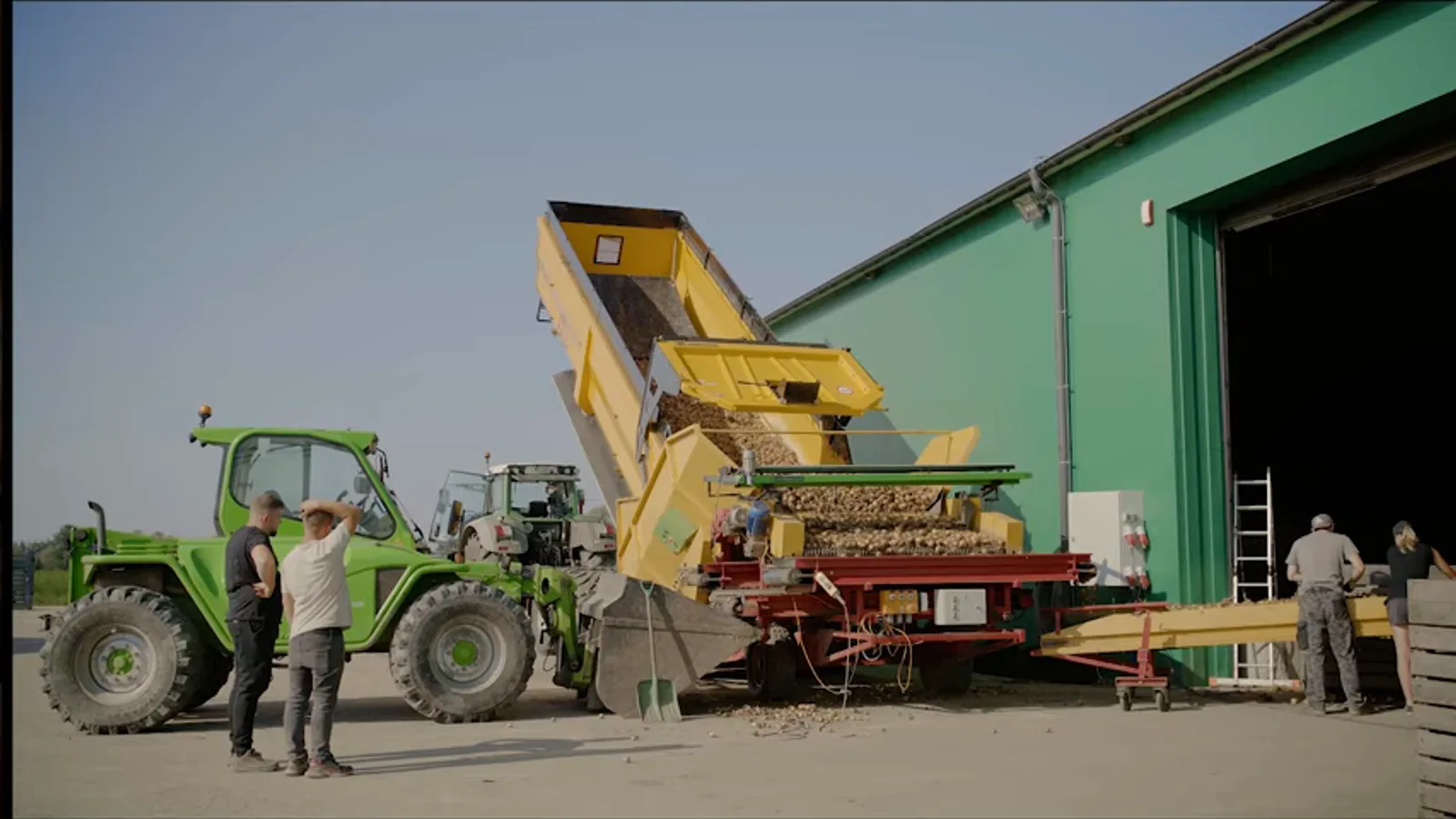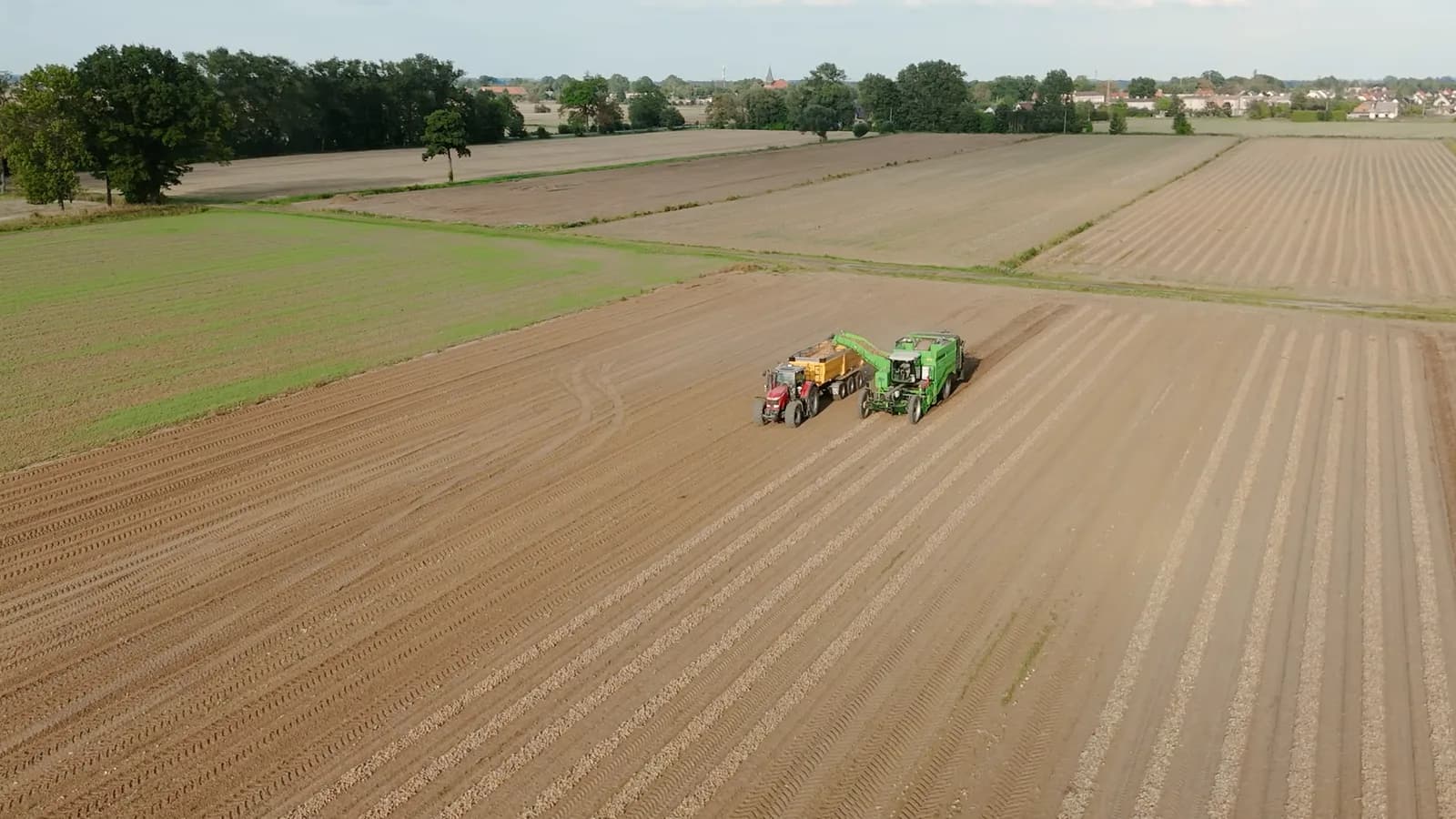
After onions we sow a winter cereal, usually wheat, and on the weaker, more acidic and wetter patches triticale. Most onion fields are cleared early, some only towards the end of September; they leave little residue and are level, but they have three weaknesses: soil compacted by carting off the crop, a weed seed bank left by a soil profile that lay bare all season, and volunteer onions that overwinter together with the diseases. Onions take up around 250 hectares of our more than 800 hectares, so every autumn the same question comes back over a large area, and we answer it with the same repeatable plan of work.
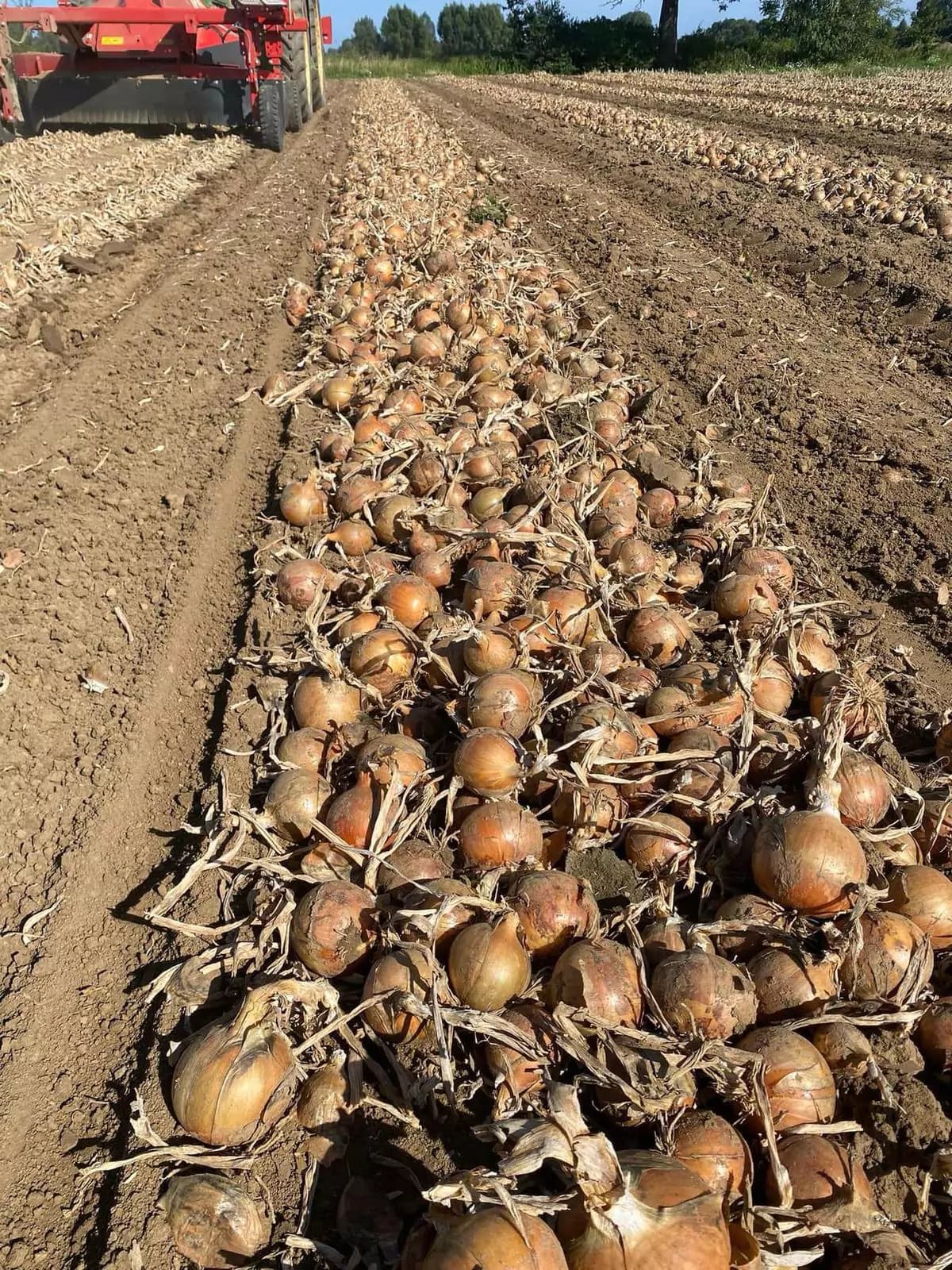
What is left in the field after the onion harvest
Onions are an unusual preceding crop. Unlike cereals or oilseed rape they leave very little biomass: dried tops and skins, no straw at all. On the one hand that is convenient, because nothing blocks the drill and there is no waiting for residues to break down. On the other hand, onions kept the soil profile bare for the whole season, so a sizeable weed seed bank is waiting in the ground and will start to emerge at the first tillage pass.
The second matter is structure. The onion harvest is heavy traffic: the harvester, trailers and tractors drive over the field in all weathers, because onions cannot be left in the windrow for ever. After a wet harvest on heavy alluvial soil there are ruts and compacted strips that have to be loosened before the cereal goes in. July 2025, when downpours brought 150-220 litres per square metre in a day in places, showed us how badly that soil can compact.
The third thing matters most for the health of onions in the years to come: lost onions and volunteers. Downy mildew overwinters in infected bulbs, and thrips in plant residues. Onions that root and survive the winter will send up tops in spring and become a source of infection for neighbouring plantings. That is why after harvest we do not leave them to chance until spring. How we spot and control the disease, we describe in our post on downy mildew in onions.
Why a cereal follows onions
Onions come back to the same field only after several seasons of other crops, because in a monoculture soil-borne diseases and pests build up. For the field a cereal is a sanitary break: it does not catch what onions catch, its dense stand smothers weeds, and the straw and roots rebuild the humus and structure of heavy alluvial soil. That is why winter wheat is the natural successor to onions on our farm, and we describe the whole system in our post on crop rotation with wheat and triticale.
Triticale goes where wheat would struggle: on patches with lower pH, poorer structure and more moisture. We sow it no later than wheat, because it copes worse with a delayed sowing date. When the onion harvest drags on, that field gets wheat, which of our winter cereals handles late sowing best. More on when triticale wins over wheat in our post on growing triticale.
A field after onions has one more advantage for a cereal: no cereal has grown on it for a year, so the pressure from stem-base and leaf diseases of cereals is low. For wheat that is a better start than sowing after another cereal.
Post-harvest tillage step by step
On fields that are cleared early, we prepare the field after onions in a few steps, always in this order:
- We tidy the field after harvest. Larger onions and heaps we pick up from the field, and the small stuff we spread over the surface so it dries out before the first tillage pass; whatever manages to root is taken out by the tillage itself.
- A shallow pass and a second one. Loosening the top few centimetres breaks evaporation, mixes in the residues and prompts weeds and volunteers to emerge. Once they are up, we destroy them with a second pass, before sowing.
- Deeper loosening where it is needed. Ruts from carting and compacted strips we loosen deeper, but only in those places and only when the soil is not wet. Alluvial soil worked wet turns to clods and cannot be worked down to a seedbed for the rest of the autumn.
- Soil testing and the liming decision. After onions we check the pH zone by zone. As standard we lime on cereal stubble a year or two before onions, because onions do not like freshly limed soil. A field after onions is an option only when there is genuinely time to spare before sowing: we do not combine lime with phosphorus fertilisers and need at least a few weeks between them, so in a short pre-sowing window we do not lime. More in our post on soil pH for onions and liming.
- Fertilising for the cereal. Phosphorus and potassium go on according to soil nutrient maps, at variable rates, and if the field was limed, only after a gap of a few weeks; wheat needs little nitrogen in autumn, so we do not apply a starter dose automatically, only after a soil test.
- Seedbed and sowing. The top layer should be settled and medium-fine, not dusty: alluvial soil worked too fine caps after rain and smothers emergence.
On fields that are cleared at the end of September there is no time to wait for volunteers to emerge. There the small stuff and the volunteers are destroyed by a tillage pass made directly before the seedbed and drilling, precisely so they do not overwinter as a source of infection. Whatever comes up in the stand in spring anyway, we catch during spring scouting and remove before it manages to sporulate. We watch such a field more closely at the next post-harvest tillage. On these fields the window between onions and the winter cereal is also too short for a cover crop; the role of winter cover is played by the wheat stand itself, which goes onto the field while it is still autumn.
The most common mistake after onions is haste on wet soil. The field is cleared early, so it is tempting to plough and sow straight away. Compacted, cloddy alluvial soil pays that back later on wheat emergence, and a few years on, on the onions.
When to sow winter wheat after onions
The maritime climate of Żuławy gives a long, mild autumn, so we sow winter wheat here a little later than in central and north-eastern Poland: the optimum window is around 20 September to 5 October. Seed-sown onions come off the field from the second half of August to the end of September, so fields after an early harvest and after set onions fall into the optimum window with the full tillage procedure, while fields cleared at the end of September we sow at the edge of the optimum window, and with any further delay in the late window, at a higher seed rate.
| Sowing date in Żuławy | Approximate seed rate | Notes |
|---|---|---|
| 10-19 September (early) | 300-350 seeds per m2 | only after the earliest-cleared fields; a lush stand in autumn means more disease and pest pressure |
| 20 September - 5 October (optimum) | 350-400 seeds per m2 | the best compromise between autumn growth and overwintering |
| 6-20 October (late) | 400-450 seeds per m2 | weaker tillering, so a higher seed rate and shallower drilling; wheat tolerates it better than triticale |
| after 20 October | the highest seed rate or a spring cereal | drill only in favourable weather; the risk of poor overwintering grows with every day |
We match the seed rate to the variety and the field, and the table is a starting point, not a rigid norm. We place the seed 2-4 centimetres deep, shallower on heavier, wetter soil. We drive along permanent tramlines with parallel guidance, so we do not double up passes or compact the soil more than we have to; how that works, we describe in our post on GPS RTK in precision agriculture.
What this stage gives the onions a few years on
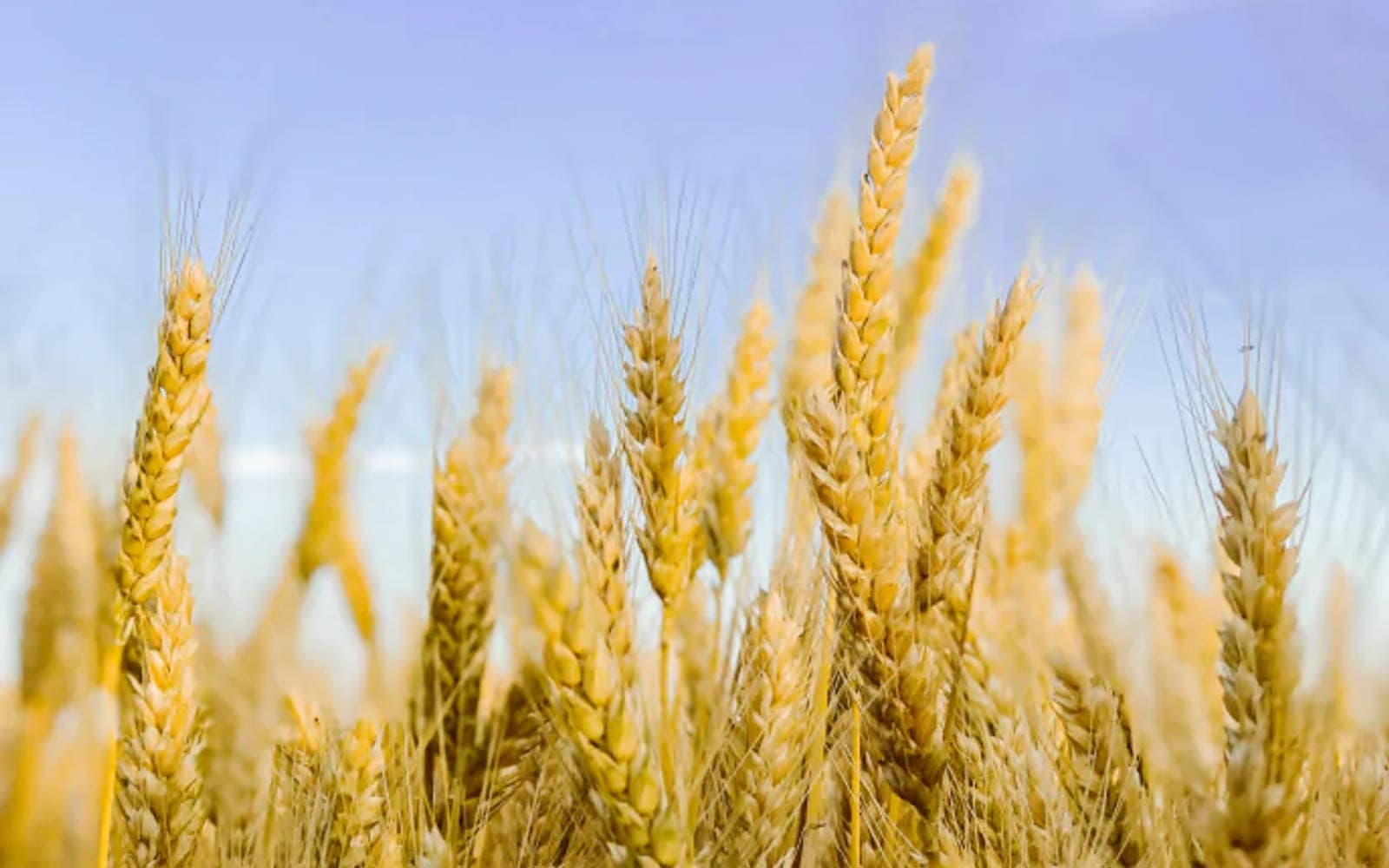
Everything we do in autumn after onions comes back to us with interest when onions return to that field. Wheat takes the weeds out of the field, roots and straw improve the structure of the alluvial soil, and the break from onion crops lowers disease pressure. That is why we choose fields for onions from among those that have been through a full cereal cycle, as we write in our guide onions from Żuławy: how we grow them.
Wheat from these fields is a proper product for us, not an add-on. We sell it as milling wheat, with the parameters agreed for every batch, and grain that does not go for milling as feed grain traded under the GMP+ certificate. If you buy wheat or triticale in bulk, write to us; we calculate the price on the basis of the going market prices.