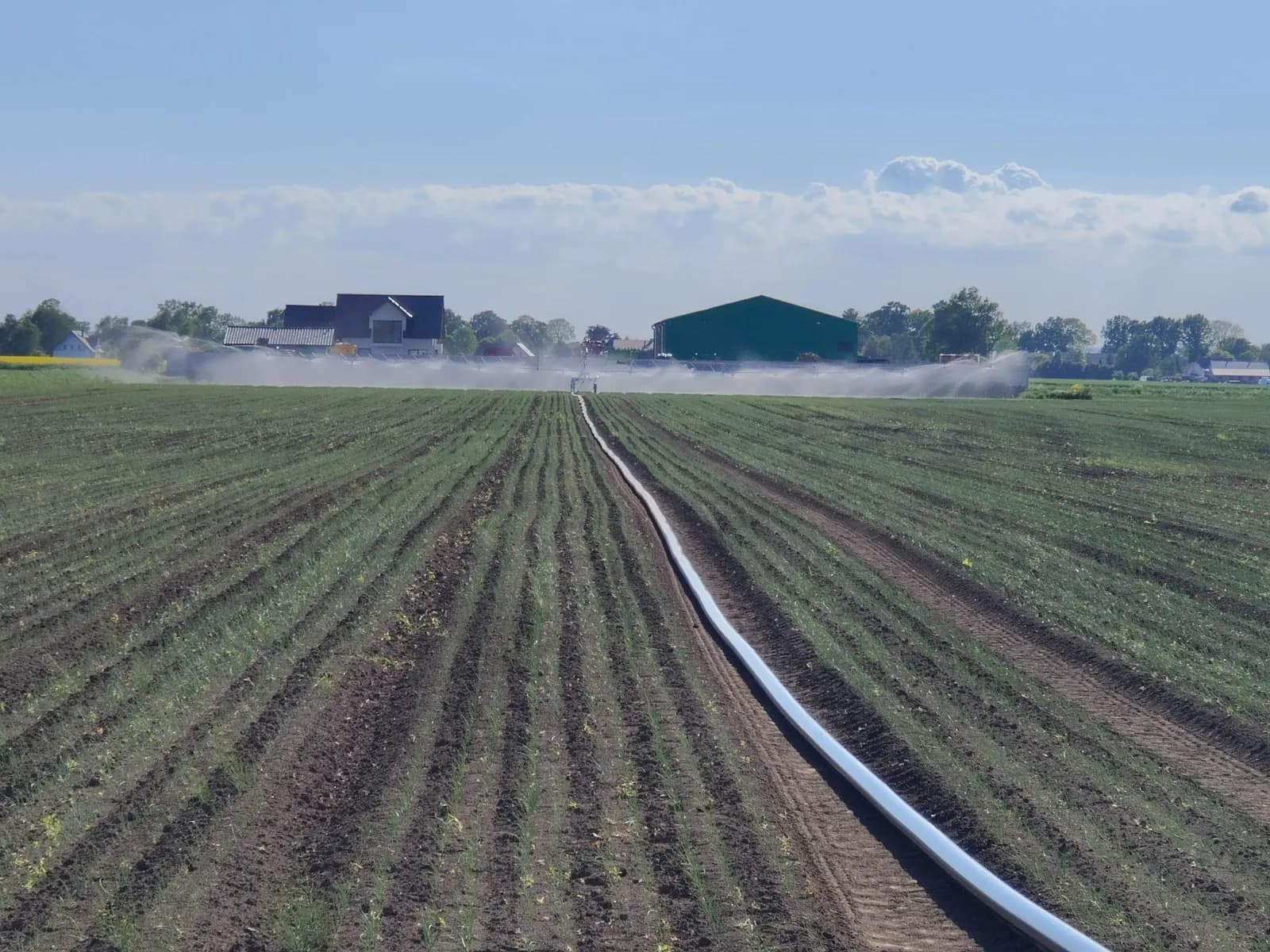
Downy mildew is the most dangerous leaf disease of onions in a damp climate, and in years of heavy pressure it can take tens of percent off the yield. It develops on cool, wet nights, and you only see it once the pathogen has been working in the crop for a couple of weeks. We grow around 250 hectares of onions in Żuławy, where fog and dew are the norm, so we treat this disease as a fixed point in the plan, not as a surprise.
What downy mildew is
The culprit is Peronospora destructor, a fungus-like organism from the oomycete group, more closely related to algae than to true fungi. That is a practical piece of information, because oomycetes need water in liquid form to develop: dew, fog or a film of rain on the leaf. Without wet leaves the infection does not start, however many spores are in the air.
We see the symptoms on the leaves, because that is where the pathogen sporulates. The bulb itself does not rot from mildew directly, but the infection can enter the plant systemically and then overwinter in the bulb or in the sets. The effect shows up at harvest and in storage: a plant with a damaged leaf area stops adding weight to the bulb, so the batch is smaller, less even and has a neck that closes poorly. That in turn opens the way to onion neck rot, which only shows itself in the store.
When downy mildew is dangerous
Downy mildew does not work in every kind of weather. It has its window, and that window can be predicted, because it depends on temperature and on how long the leaf stays wet.
| Conditions in the crop | What the pathogen does |
|---|---|
| Nights with fog or dew, 10-14°C, humidity close to 100 percent | sporulates most intensively, the infection starts in earnest |
| A warm, windy day, leaves drying quickly | spores die fast, the risk drops |
| Cold below a few degrees | sporulation practically stops |
| A dense, lush crop after too much nitrogen | leaves stay wet for a long time, the risk rises despite good weather |
The worst pattern for us is a warm day and a cool, foggy night, the typical weather from June right up to harvest in Żuławy. A warm, windy day does no harm by itself; the trouble starts when a long, wet night follows it. The leaf then stays wet for several hours, the pathogen sporulates, and in the morning the wind carries the spores across the field.
How we recognise it in the field
The first signal is not spots but single plants standing out from the rest of the crop: paler, shorter, with slightly bent leaves. These are the primarily infected plants, usually grown from infected planting material. After a dozen or so days a focus of disease forms around them.
- Oval, paling spots on the leaves, stretched along the leaf, at first without a clear edge.
- A grey-violet bloom on the spots, best seen in the morning while the leaves are still wet. That is the pathogen sporulating.
- Yellowing and collapsing leaves at the spot, starting with the older, lower leaves.
- Darkening of the infected tissue, once the fungi that cause black mould move in secondarily on the weakened leaf.
The symptoms come with a delay, usually a dozen or so days after infection, and the following sporulation cycles then come every few days. So we scout the fields regularly and look at the weather forecast instead of waiting for the first visible bloom. We write about the other threats in our overview of onion diseases and pests.
Where the first infection comes from
The pathogen does not come out of nowhere. It overwinters as mycelium in infected bulbs and in sets, its resting spores stay in the crop residues, and in spring a few plants from such a source are enough to start an avalanche. On top of that come spores carried by the wind from neighbouring plantings, including gardens and waste heaps.
The most common way the disease enters a planting is infected planting material and volunteers from last season. Healthy sets, and onion residues that dry on the surface and go under tillage instead of onto a heap beside the field, do more for protection than any treatment applied after the fact.
How we prevent downy mildew in Żuławy
Our protection starts long before the first treatment. The point is to give the pathogen as few chances as possible and to keep the crop wet for as short a time as possible.
- Crop rotation. Onions come back to the same field only after several seasons of other crops, and their residues go to break down, not onto a heap beside the field. How we arrange the rotation, we describe in our post on crop rotation in onion growing.
- Healthy planting material and an even crop. We sow and plant with GPS navigation and RTK correction, so the rows are even and the crop is airy. A dense, uneven crop holds moisture far longer.
- Dry feet and airflow. On the heavy alluvial soils the water has to have somewhere to go. Working ditches and drainage mean less fog at ground level and leaves that dry faster, which we write about in our piece on land drainage in Żuławy.
- Sensible irrigation. We apply water so the leaves have time to dry, because leaves that stay wet for a long time are the best conditions the pathogen can get.
- Scouting and the risk window. What decides on a treatment is the run of the weather and what we see while scouting, not the calendar. Scouting is how we catch the primary infections and check whether the protection worked. We do not spray routinely every week.

We keep an eye on nitrogen too. Over-fertilised onions build a lush, dark green crop that looks impressive but dries more slowly and stays wet for longer. So we balance the nitrogen rates against what the crop really needs, not against how the field looks.
What downy mildew means for the onion buyer
For a packing house or a processor, downy mildew is not an agronomic curiosity but a question of how long the produce lasts. A planting where the disease ran unchecked gives smaller onions with necks that close poorly, and they spoil faster in the store. A batch from such a field can look fine on the day of collection and fall apart after two months of storage.
That is why the fight for onions that keep starts in the field and ends with 2-4 days of curing and a controlled store. The work for the next season starts right after harvest anyway: the residues dry on the surface and go under tillage, we pick a site far from last year's onions and make sure the material for the next sowing and planting is healthy. We describe that whole chain in our guide to how we grow onions in Żuławy. You will find the varieties and delivery formats in our onion offer, and for produce for a packing house or a processing plant, write to us.