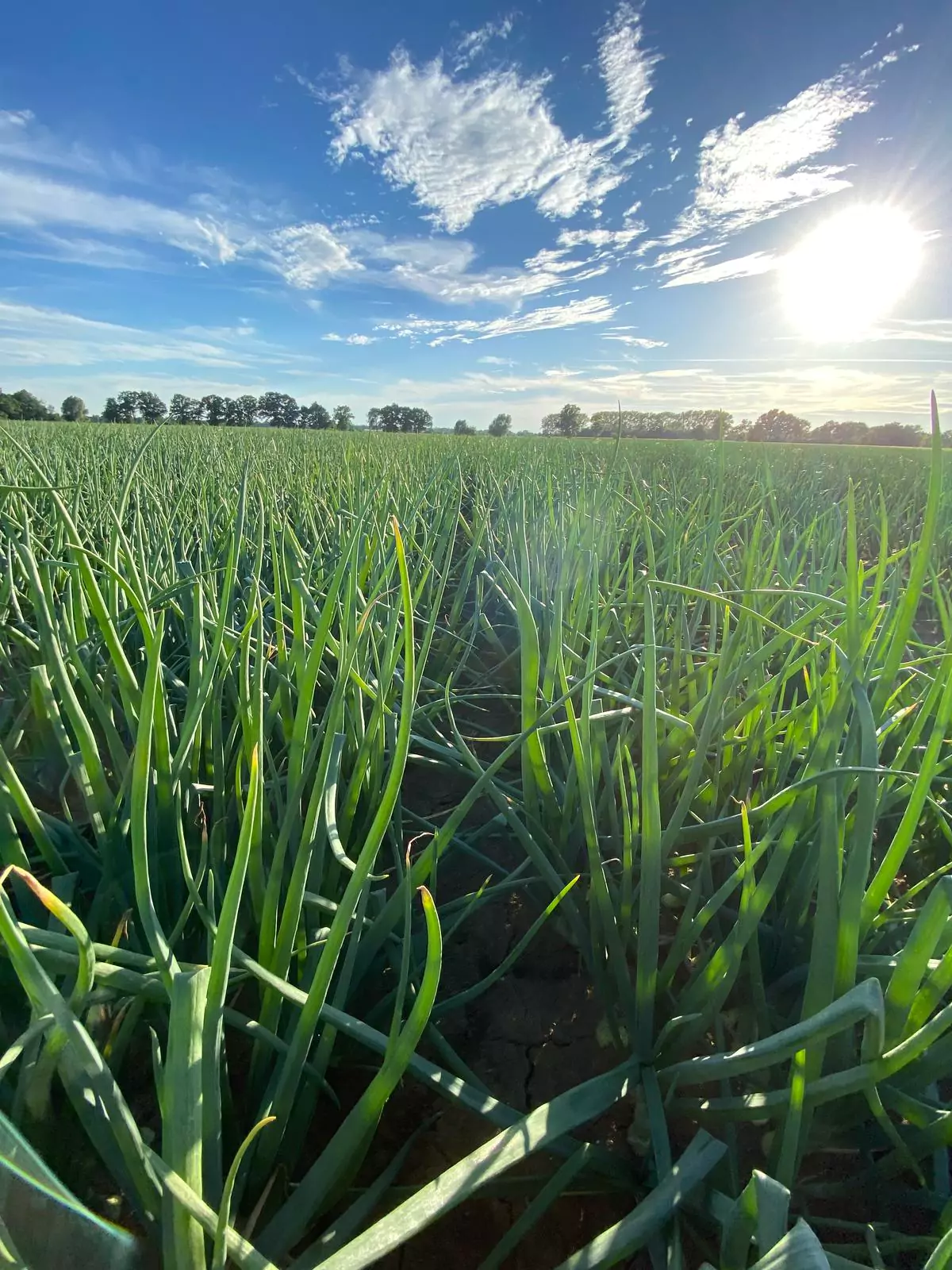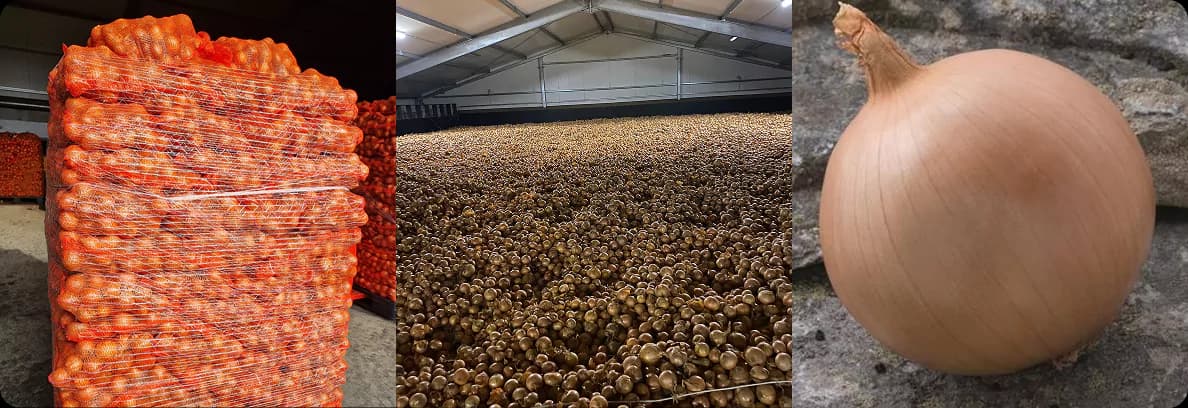
If an onion looks healthy on the outside, but once cut open one or several scales inside are glassy, watery or brown, it is usually a matter of bacteria, not fungus. Bacterial rot most often starts at the neck or at a wound, and for a long time it often gives no sign on the outside. We release onions from around 250 ha from our own 13 000 tonne store through winter and spring, so we see this disease from the side that matters to the buyer: what a batch looks like after months in storage.
Why onions rot from the inside
A healthy onion has several dry skins on the outside, and fleshy scales beneath them. Bacteria do not get through dry skin. They enter where the tissue is open: through a neck that has not yet dried, and through wounds from the field or from harvest. Then they move down along the fleshy scales, while the dry covering stays untouched.
For bacterial soft rot, the Institute of Horticulture's integrated onion protection methodology says it outright: the surface of affected onions can look undamaged. The exception is sour skin, where the outer fleshy scales rot and the centre stays firm. The source is mainly bacteria living in the soil, sometimes contaminated water. Whether infection happens is decided by wounds and free water on the surface of the onion, and most infections arise at harvest, when cutting the tops and during care operations.
Which bacteria are behind it
The Institute of Horticulture's methodology names three culprits of onion bacterial disease. Each leaves a slightly different trace on the cross-section:
| Disease | Causal agent | What you see on the cross-section |
|---|---|---|
| Bacterial soft rot | Pectobacterium carotovorum (formerly Erwinia carotovora) | starts at the neck: the fleshy scales turn watery and glassy, then change into a slimy mass with a repulsive smell |
| Slippery skin | Burkholderia gladioli pv. alliicola | no change on the outside except a soft neck, inside the scales look soaked in water, later they darken and fall apart |
| Sour skin | Burkholderia cepacia | the outer fleshy scales rot, turn yellow and soft, the centre stays firm, there is a smell of vinegar |
According to UC IPM, bacteria can spoil just the centre of the bulb, just the outer scales, or only selected scales. One caveat: from symptoms alone you cannot reliably tell the species, and that takes laboratory testing. For the buyer, more important than the name is how many such bulbs sit in the batch.
Fungus or bacteria: how to tell on the cross-section
Bacterial rot is easiest to confuse with neck rot, because both start from the top and both can be watery. The difference is in what you see under the skin. Neck rot is a fungus of the genus Botrytis: it leaves a grey mould and black sclerotia, which we describe in our post on onion neck rot and storage diseases. Fusarium basal rot goes from the base upwards and gives white mycelium on the bottom of the bulb. Black mould leaves a black, powdery coating under the dry skin.
Bacteria do not make a coating. They leave glassy, watery scales, slime and a smell. If after cutting you see no mould, and one scale inside looks scalded, bacterial disease is very likely, though only laboratory testing gives certainty.
What favours bacteria
The Institute of Horticulture's methodology states that bacterial diseases are favoured by temperatures of 18-30 °C with high humidity, both in the field and in the store. In practice the risk grows when several things meet at once:
- water on the onion just before and during harvest, that is downpours, flooding, hail or irrigation right at the end of the season,
- wounds, from lifting, from cutting the tops, after hail,
- immature onions with a thick, juicy neck, harvested before the tops have collapsed,
- weeds during ripening, which prolong the drying of the neck,
- excess nitrogen, after which the neck stays soft for a long time.
Żuławy knows wet summers. In the 2025 season downpours gave 150-220 l/m2 in a day in July, with flooding and overflowing drainage canals. A season like that does not mean a batch will be diseased, but it means we watch harvest and curing twice as closely.
How we limit the risk
There is no treatment in storage that kills bacteria. Protection happens in the field, at harvest and in the first days after harvest. With us it looks like this:
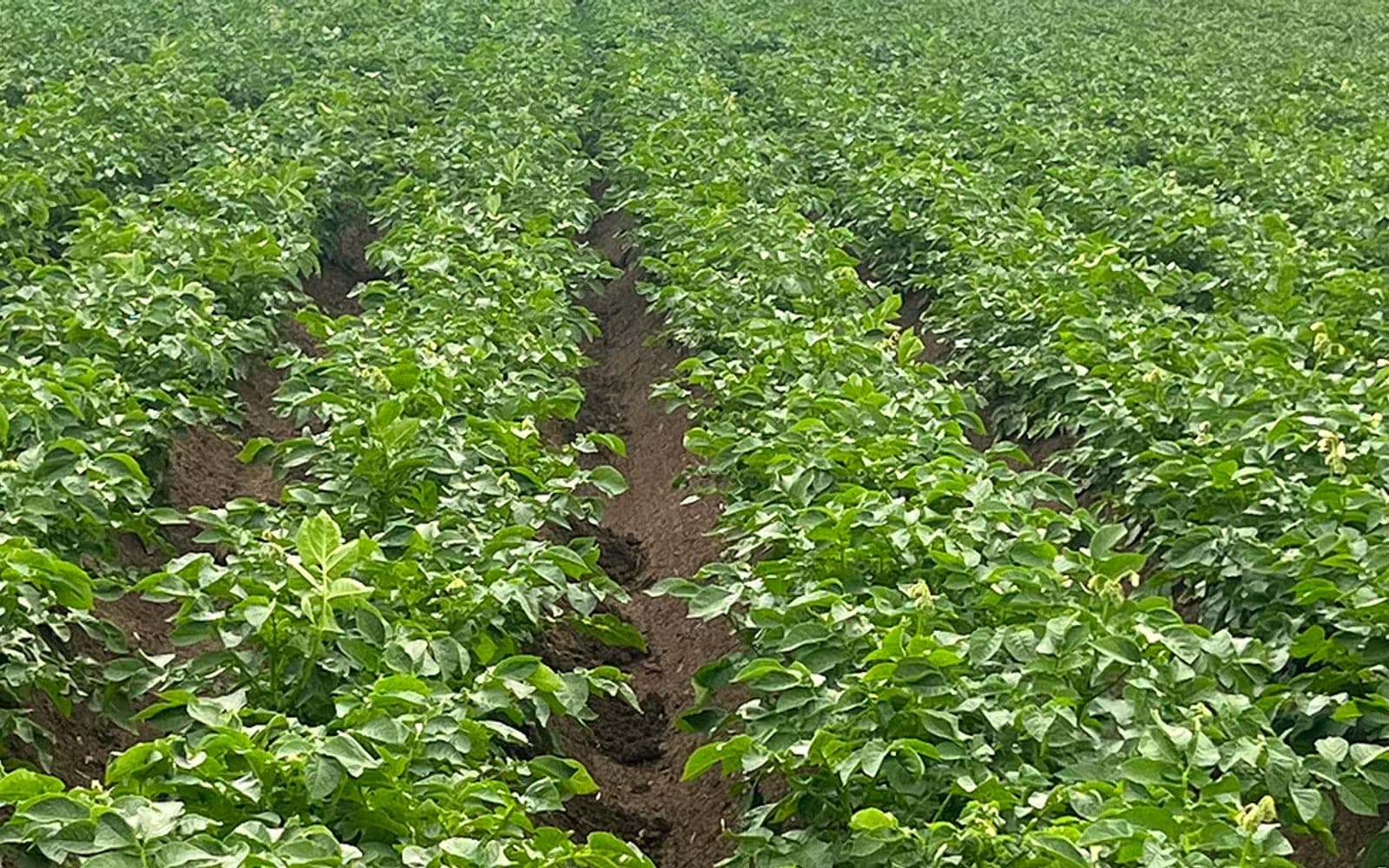
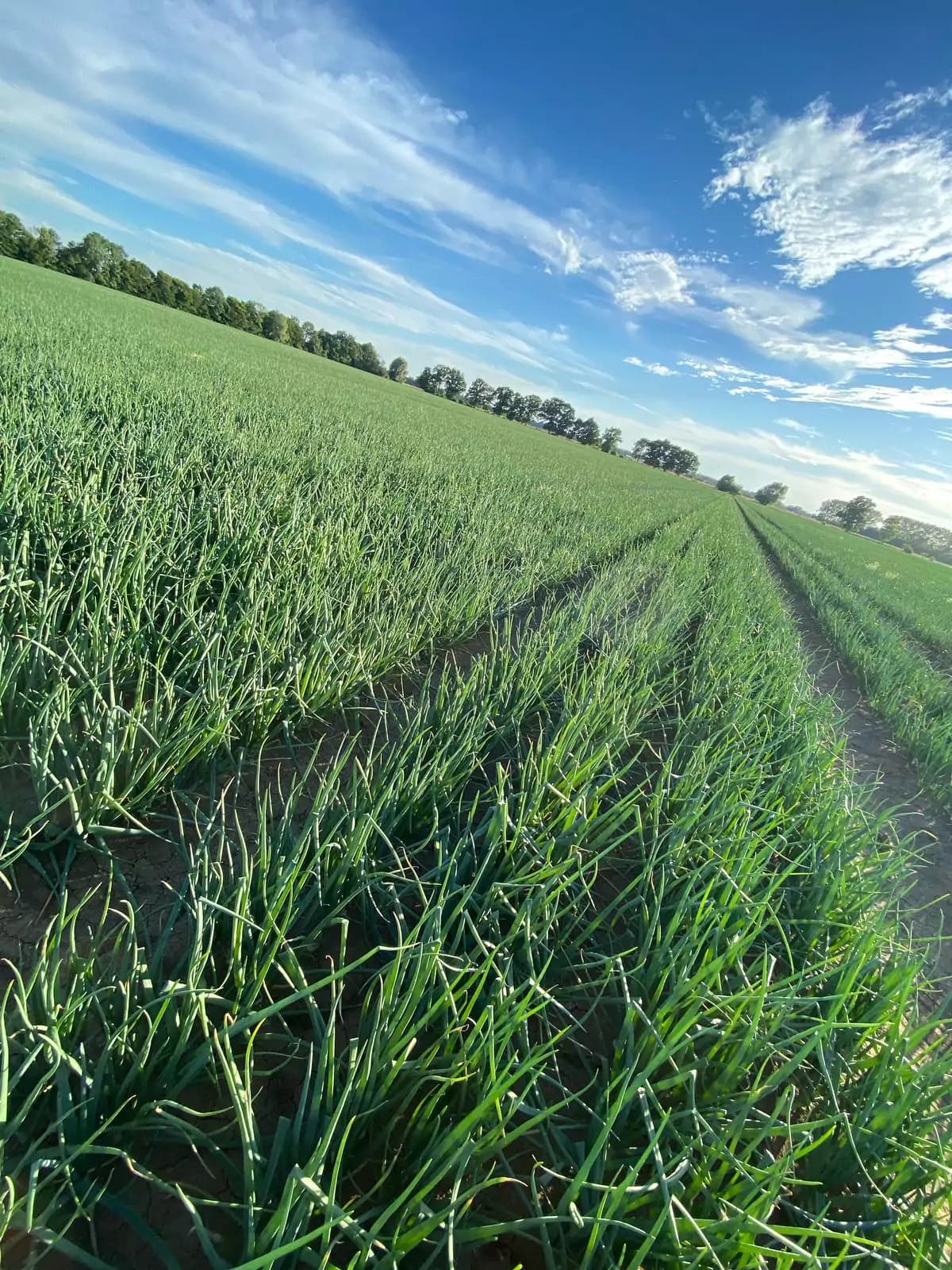
- Growing. We grow according to the principles of Integrated Plant Production, keep a crop rotation and do not over-fertilise with nitrogen, so the neck has a chance to close.
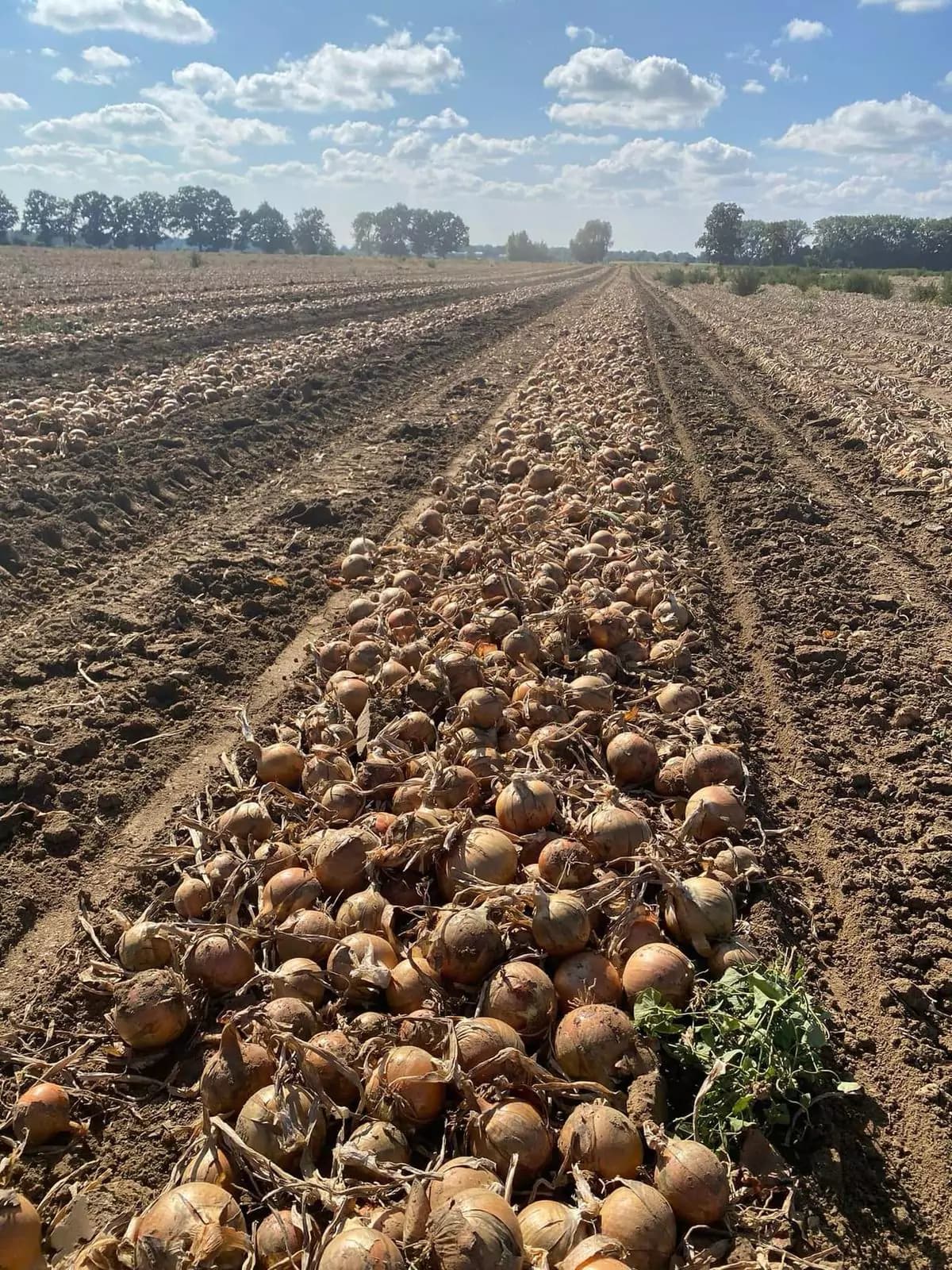
- Two-stage harvest. The Grimme WV 180 windrower undercuts the onions and lays them in windrows to finish drying, and only then does the AVR Puma 3 self-propelled combine pick them up from the windrows.
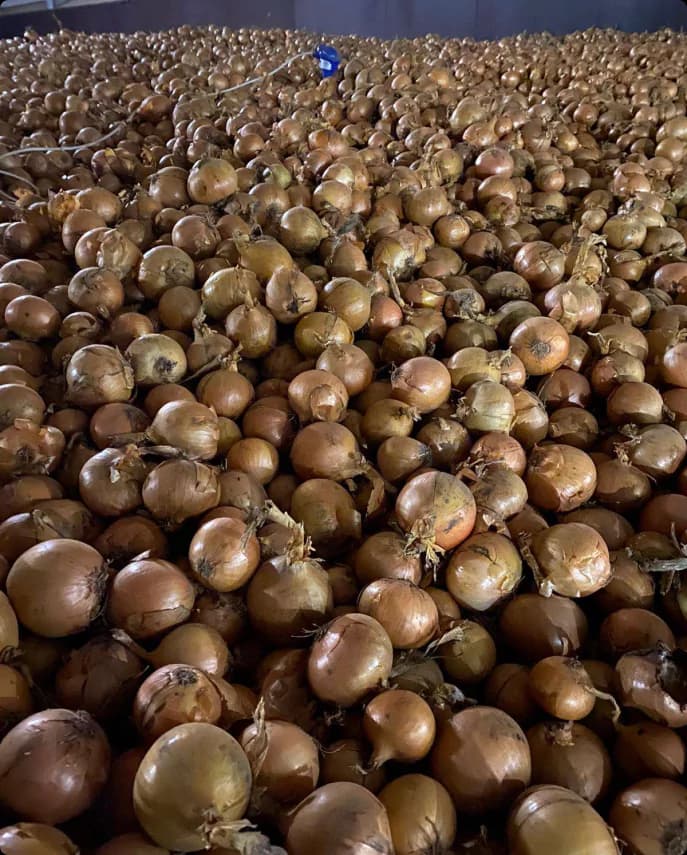
- Curing. In the store we cure the onions with a stream of warm, dry air for 2-4 days. Speed matters: the neck has to dry before bacteria manage to go deeper, and there must be no free water standing on the onion. How we do it step by step, we describe in our post on curing onions before storage.
- Checks during storage. We cut onions from different places in the batch and check the neck and the fleshy scales. A batch in which changes appear we send for faster sale or for grading, instead of holding it until spring.
The optical sorter rejects bulbs with defects visible from the outside. Bacterial rot gives no such defect for a long time, which is why the condition of a batch is also decided by the cross-section of samples, not only by the camera. We write more about how we take onions through winter in our guide storing onions.
How to assess a batch on receipt
The buyer does not have to take our word for it. Three simple tests tell you more about a batch than its look from the outside:
| Test | How to do it | What to watch for |
|---|---|---|
| Cross-section | cut a dozen or so onions lengthways from different places in the batch | glassy, watery or brown fleshy scales, inside or just under the dry covering |
| Pressure on the neck | squeeze the neck with your fingers | a soft neck, liquid leaking out |
| Smell | smell the cross-section and the sack | vinegar or a repulsive, rotten smell |
The reference point is the general EU marketing standard, which onions fall under. It requires the produce to be sound, free from rot and from signs of deterioration that make it unfit for consumption. It allows a tolerance of 10 percent by number or weight of produce not meeting the minimum requirements, of which at most 2 percent may show signs of rot. This standard applies to produce prepared and packed for dispatch and does not cover produce labelled as intended for industrial processing, where the thresholds are set by the contract. Specifications also often refer to the UNECE FFV-25 standard, which in Class I allows at most 1 percent of rotten bulbs. More on how defects and tolerances are counted, we write in our post on onion quality classes under the marketing standard.
One onion rotten in the middle does not decide a whole delivery. It is worth checking the share of such bulbs on a larger sample and only then deciding what to do with the batch. A symptom that repeats says more than a single case.
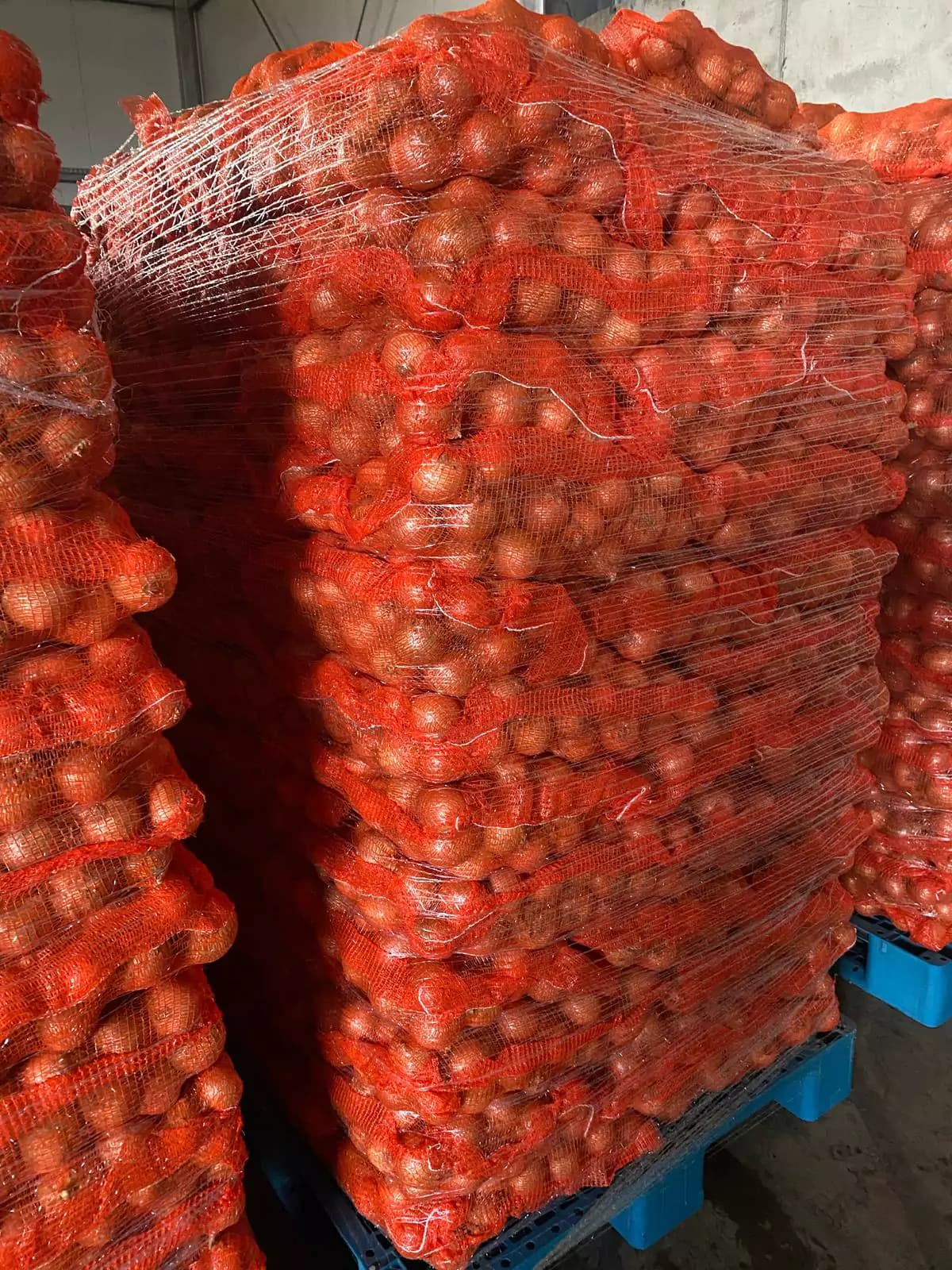
We release onions from the store after checks and selection. You will find sizes, packaging and delivery dates in our onion offer, and please send questions about a specific batch through the contact form.