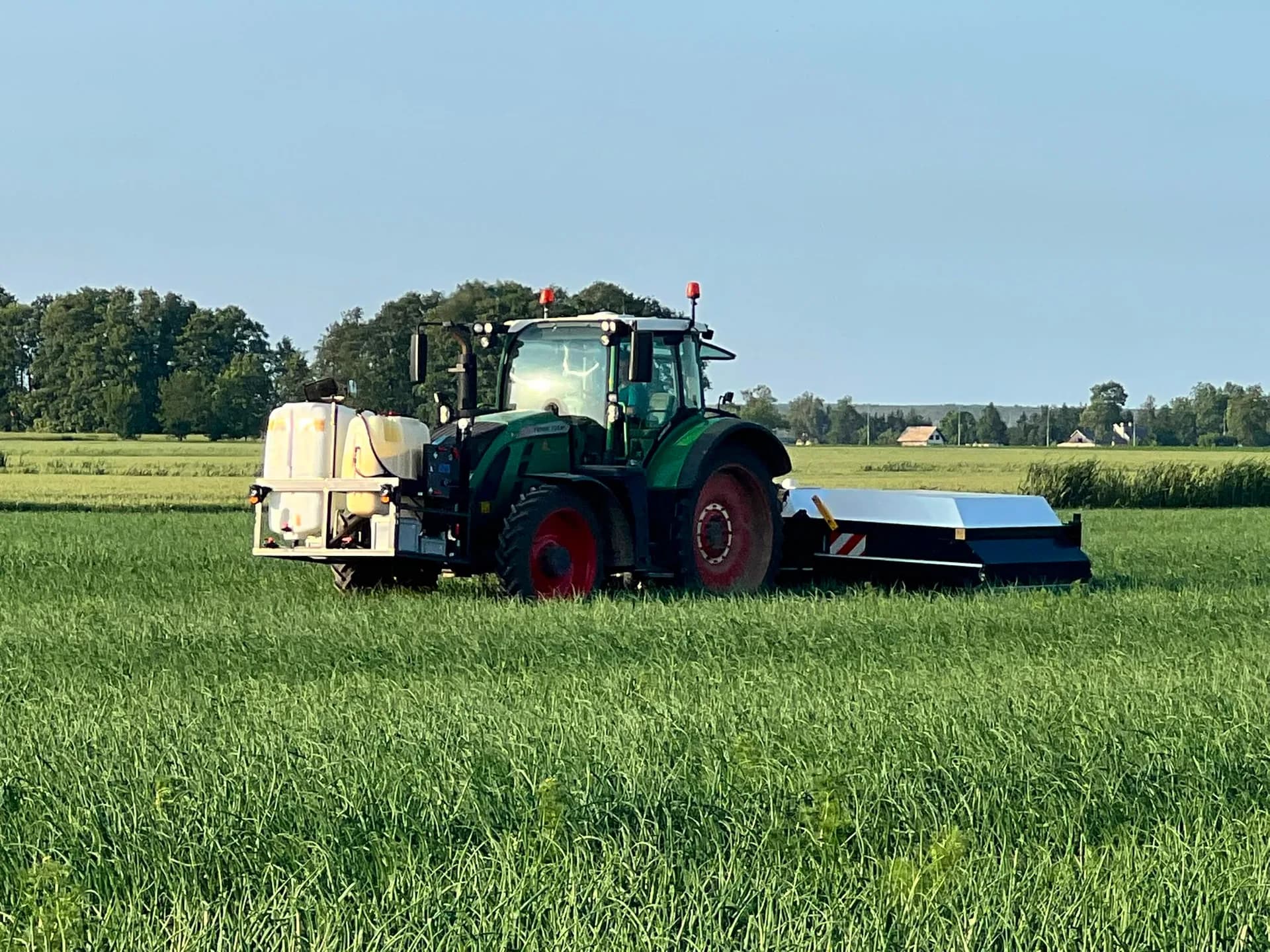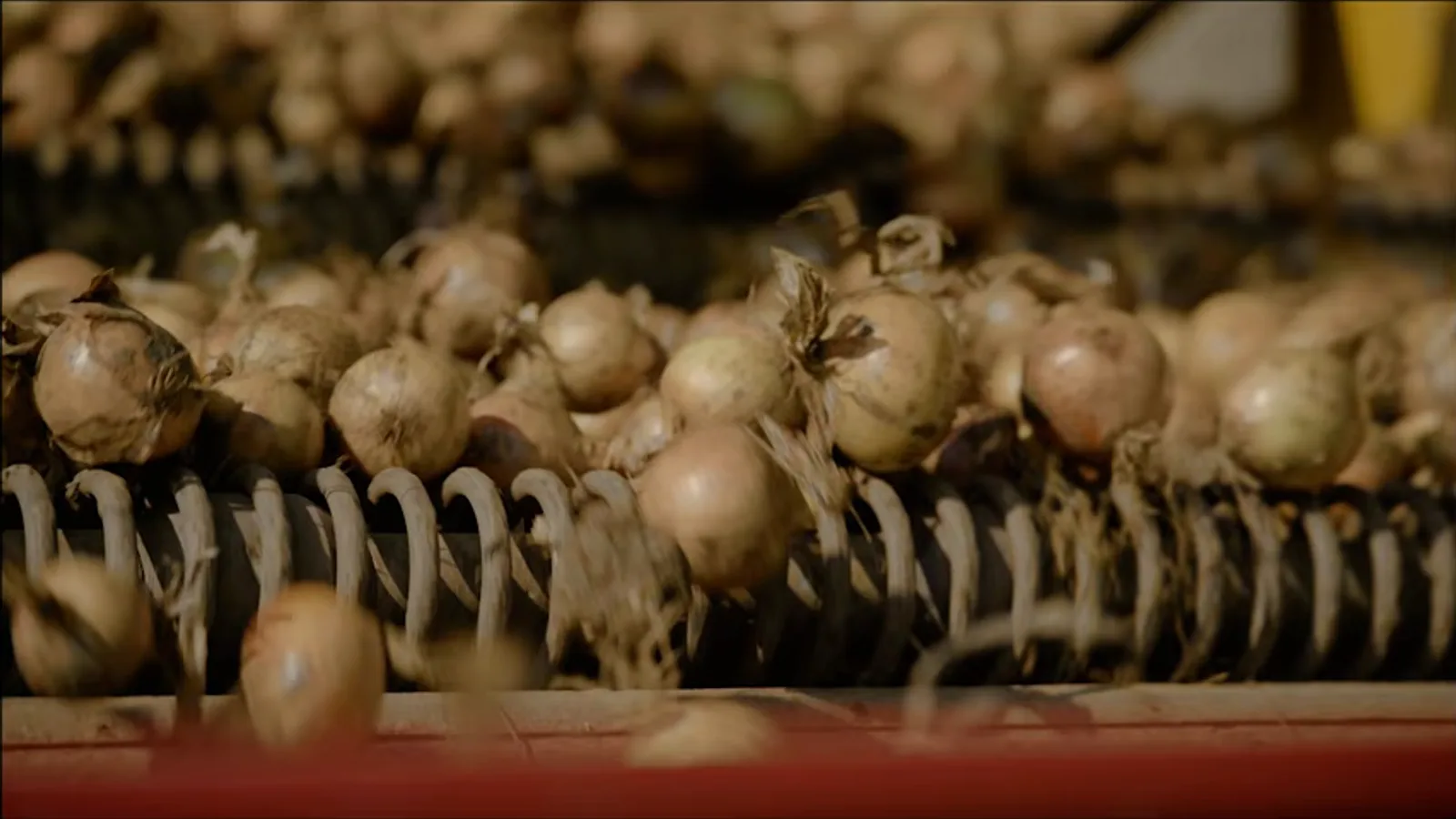
An onion's quality class tells you how many defects a batch may contain and how uniform the produce in a pack has to be. In wholesale trade we refer to the UNECE FFV-25 marketing standard for onions, which sets out the minimum requirements, two quality classes (I and II), the rules for sizing by diameter and the tolerances. We explain what these provisions mean in practice and how we check them on our own line before onions from our roughly 250 hectares leave for the packing house.
Where onion quality classes come from
In the European Union, onions fall only under the general marketing standard for fruit and vegetables. The specific standards in force since 2025 under Delegated Regulation (EU) 2023/2429 cover eleven products, such as apples, tomatoes and peppers, and onions are not among them. The general standard says only that produce must be sound, clean and of marketable quality.
That is why the trade turns to the UNECE FFV-25 standard, drawn up by the United Nations Economic Commission for Europe. Produce that conforms to it is deemed to meet the general EU standard, and its provisions are the common language of supplier, packing house and quality control across Europe. When an order says "Class I, size 50-70", both sides know exactly the same thing, whether the onions are going to Poznań or to Hamburg. How we set the size for a particular plant, we describe in the post on onion size for processing. Here we focus on class, meaning quality.
Minimum requirements: what every onion has to meet
Before we talk about class at all, a batch has to pass the minimum requirements. They apply to both classes.
- Whole, sound and clean onions, free from rot and from visible foreign matter.
- Free from frost damage and from excess moisture on the surface.
- Sufficiently dry: for onions intended for storage, at least the two outer skins and the neck must be completely dry.
- No hollow or tough neck, practically free from pests and from pest damage to the flesh.
- Stem twisted off or cut cleanly, no longer than 6 cm.
- Free from any foreign smell or taste.
The standard also says the onions must withstand transport and handling and arrive at their destination in satisfactory condition. In practice that sentence translates into the work we do before dispatch: drying, sorting and checking every batch.
Class I and Class II: the differences
The onion standard knows only two classes. There is no Extra Class of the kind found for apples or tomatoes. The difference between Class I and Class II comes down to how many defects are allowed, and which ones.
| Feature | Class I | Class II |
|---|---|---|
| Firmness | firm and compact | reasonably firm |
| Sprouting | not allowed | early signs allowed within the tolerance |
| Roots | practically free of root tufts | root tufts allowed |
| Shape and colour | slight deviations from the variety type | more pronounced deviations |
| Staining on the skin | not affecting the last dry skin, up to 1/5 of the surface | not affecting the last dry skin, up to 1/2 of the surface |
| Outer skin | superficial cracks and partial absence of skin, provided the flesh is protected | skin missing on up to 1/3 of the surface, small healed cracks and bruises |
| Signs of disease and pests | none | slight, healed, with no damage to the flesh |
Put simply: Class I is the produce a retail chain expects in a net on the shelf. Class II is onion that is perfectly good to use but has cosmetic defects, and it more often goes for peeling and processing. What to look at in practice when grading a batch, we cover in the checklist how to recognise good-quality onions.
Class and size are two independent parameters. Class describes quality and appearance, size describes dimensions. The buyer specifies both in the order, and we check both separately.
Sizing by diameter and uniformity in the pack
The standard sizes onions by the maximum diameter of the equatorial section. The minimum diameter is 10 mm. What matters most to the buyer, though, is the uniformity rule: the range of diameters in a single pack may not exceed a set value, which depends on the size of the smallest onion.
| Smallest onion in the pack | Maximum difference in diameter |
|---|---|
| 10 to under 20 mm | 5 mm |
| 20 to under 40 mm | 15 mm |
| 40 to under 70 mm | 20 mm |
| 70 mm and over | 30 mm |
That is why the usual commercial grades look like 40-60, 50-70 or 60-80 mm, not 40-90. The uniformity is done for us by the DOWNS CropVision optical sorter, which scans every bulb through 360 degrees, separates the grades and rejects defective bulbs, stones and clods on the spot, at up to 100 tonnes an hour.
Tolerances: how many defects a batch may contain
No batch is one hundred percent perfect, and the standard allows for that. Tolerances are counted as a percentage of the number of bulbs or of the weight in the pack.
- Class I: up to 10% of onions that do not meet Class I requirements but fall within Class II; of which no more than 1% may fail the minimum requirements or be rotten.
- Class II: up to 10% of onions that meet neither Class II nor the minimum requirements; of which no more than 2% may be rotten. In addition, up to 10% of onions with early signs of sprouting are allowed.
- Size: in both classes, up to 10% of onions outside the declared grade.
A tolerance is a margin for the unavoidable, not a target. A batch that leaves us as Class I has to still be Class I after unloading, so we sort more strictly than the standard requires and leave ourselves a margin for transport.
How we grade class here, before the onions leave
The standard describes produce at the moment of inspection, and we are responsible for it still meeting that standard when it reaches the buyer. That is why grading begins long before packing: from drying the neck after harvest, through storage in steady cold, to optical sorting and hand checks of samples from every batch. On top of that come the GlobalG.A.P. and GRASP certificates and the residue analyses, which the buyer receives together with the delivery documents.
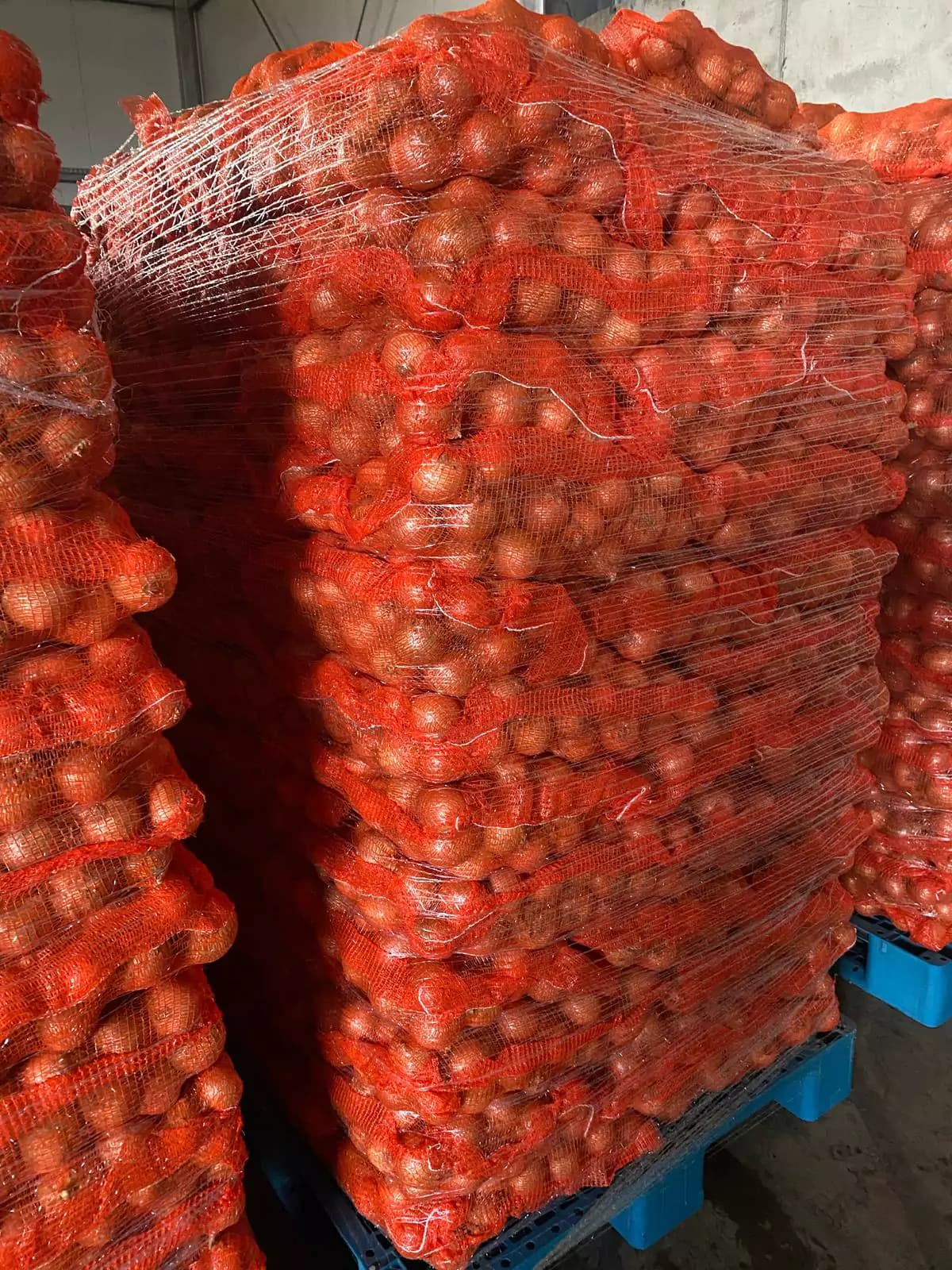
On that basis we build our wholesale onion offer for packing houses and processors: yellow and red onions in Class I, in the agreed grade, packed loose, in big bags or in nets, available all year round thanks to our 13,000 tonne store. Details of varieties and packaging are on the onions in our offer page. If you need a specific class and size for your plant, write to us and we will prepare an offer to your specification.