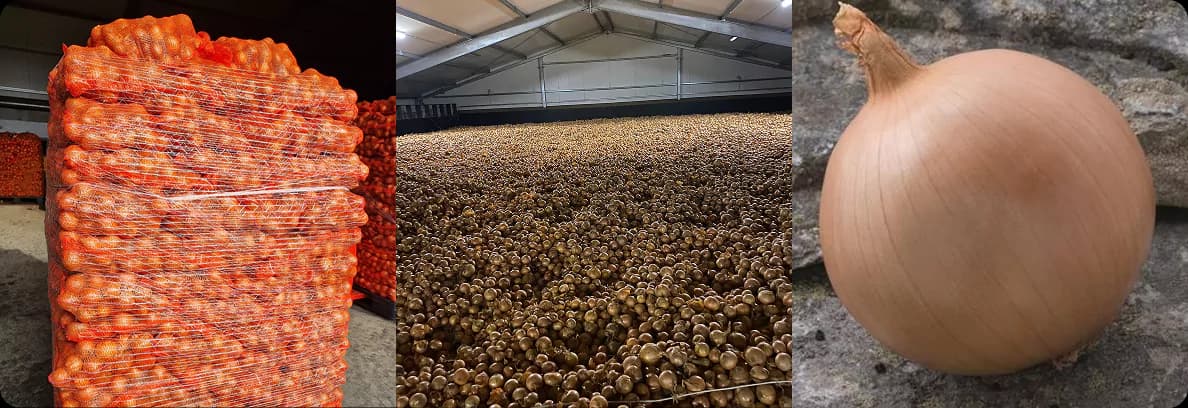
You can tell good onions by four things: a thin neck that has dried right through, a dry skin that clings tightly, a firm bulb that does not give under your fingers, and no stains or moisture under the skin. These are the four traits we check before any batch goes into store. In this post we set out the full checklist and explain why these particular traits decide whether onions last a month or half a year.
We write this from the perspective of a farm that grows around 250 hectares of onions in Żuławy, harvests roughly 60 tonnes per hectare and puts the crop into its own store for around 13,000 tonnes every year. So we judge a batch not once, but with every load that comes off the field.
The good onion checklist
We always start with the same set of traits. Every one of them can be checked in the field, without a laboratory, in a matter of seconds on a handful of onions taken from several places in the batch.
| What we check | What good onions look like | Warning sign |
|---|---|---|
| Neck | thin, dry, dried right through, closed | thick, fleshy, damp or soft |
| Skin | dry, rustling, true to the colour of the variety, clings tightly | cracked, lifting, damp, blotchy |
| Firmness | bulb hard, does not give under pressure | soft, springy, "spongy" under the fingers |
| Shape and evenness | typical for the variety, size even across the batch | many split, oversized or undersized bulbs |
| Basal plate (base) | dry, no new roots coming through | damp, with roots regrowing |
| Smell | neutral, earthy | sour, rotten, obvious the moment you open the sack |
None of these traits works on its own. A firm onion with a neck that has not dried down will still rot from the top, and a beautiful dry skin will not save a bulb that is already going inside.
The neck: the first and most important test
The neck is the way into an onion. As long as it stays damp, fungi have an open road into the bulb, and the usual result is neck rot, which only shows up after a few weeks in store. So before a batch goes in, we squeeze the neck between our fingers: it should be paper thin, dry and completely closed.
An onion with a thick, fleshy neck has usually grown too long or had too much nitrogen late in the season. We take those out at the sorting stage, because one rotting bulb can heat up and infect the whole nest around it.
The skin: the second layer of protection
The dry outer skin is the onion's natural packaging. It protects the flesh from moisture, scuffing and infection. A good skin rustles, shows the clear colour of the variety and holds onto the bulb when you rub it in your hand.
A cracked or lifting skin is a double loss. First, it opens the way to disease. Second, it drags down the look of the produce, and a wholesale buyer sees onions through their own customer's eyes as well. The skin usually suffers when onions lie too long on wet ground after lifting, or when they pass through machinery set up too aggressively.
Firmness, or what you feel in your hand
Firmness tells you about the state of the fleshy scales inside. A healthy, ripe onion is dense and heavier than it looks. If the bulb gives under your thumb, it means either that it is starting to rot from the inside, or that it was harvested unripe and has already lost water.
It is worth repeating this test on a dozen or so bulbs from different parts of the batch, not just off the top of the sack. Defects are rarely spread evenly: more often they sit in produce from one poorer corner of the field.
Defects you cannot see straight away
Some problems only show up weeks later. So when we assess a batch, we cut a few onions in half and look at the cross section.
- Neck rot: glassy, watery scales just below the neck, later grey mould.
- Bacterial soft rot: a single fleshy scale soft and translucent, with foul smelling liquid running out under pressure.
- Mechanical damage: dents and scuffs from machinery, which become a gateway for infection in store.
- Greening and sun scald: the result of onions lying uncovered in the field for too long.
We write more about where these problems come from and how we prevent them during the growing season in our post on onion diseases and pests.
How we check onions here, step by step
Quality assessment is not a one off test for us, it is a series of gates on the way from the field to the buyer.
- In the field, before harvest. We look at the tops and the neck. We only move once the tops have gone over and the neck is starting to dry down.
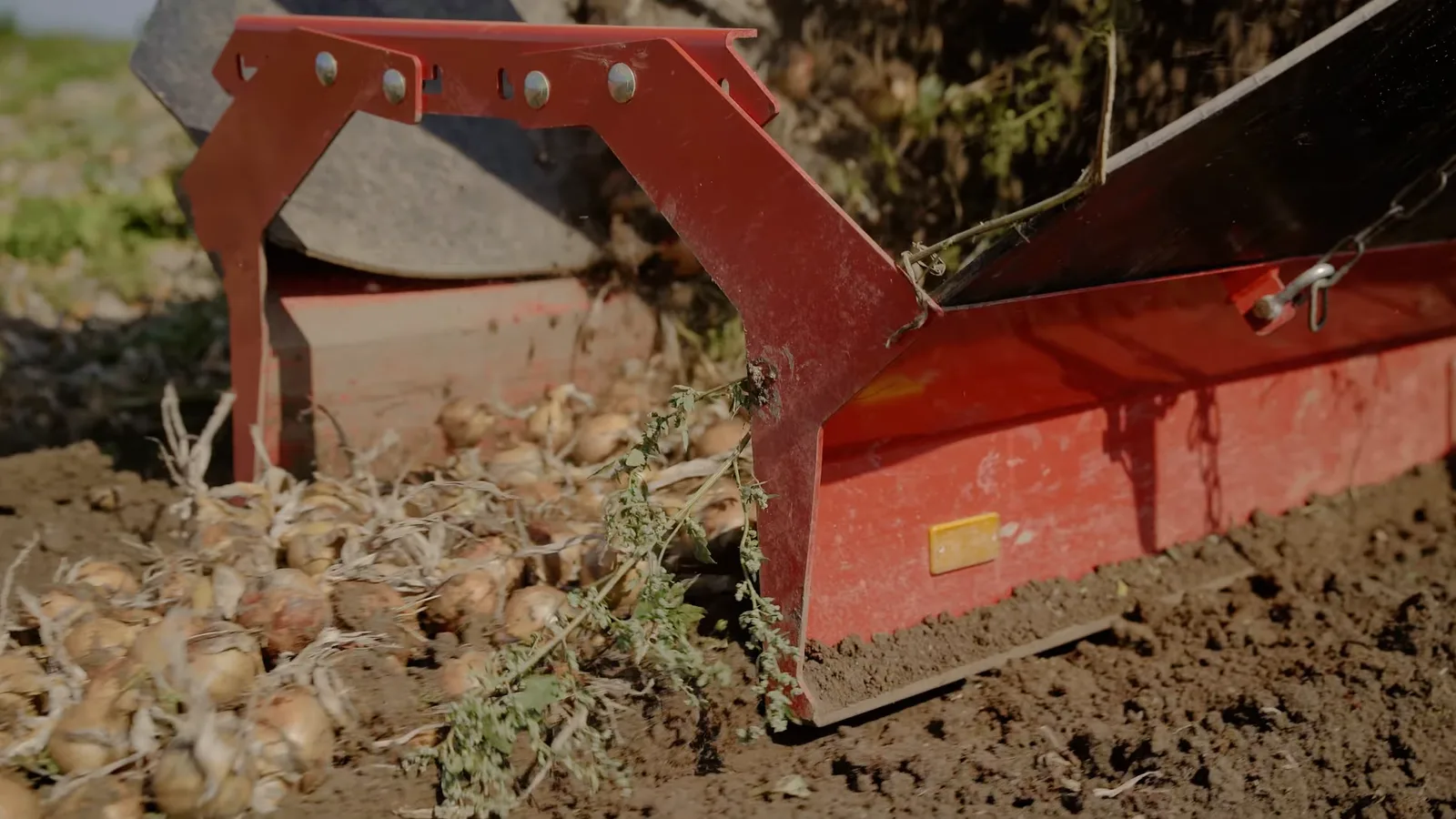
- After lifting, in the windrow. The onions dry down in the field while we check that the skin is colouring up and that there is no sun scald.
- On intake to the store. We check moisture and the state of the neck. Batches in different condition are kept apart, so one does not drag the other down.
- During curing. We dry the onions with warm air for 2 to 4 days, until the neck closes completely. We described this in our piece on drying onions before storage.
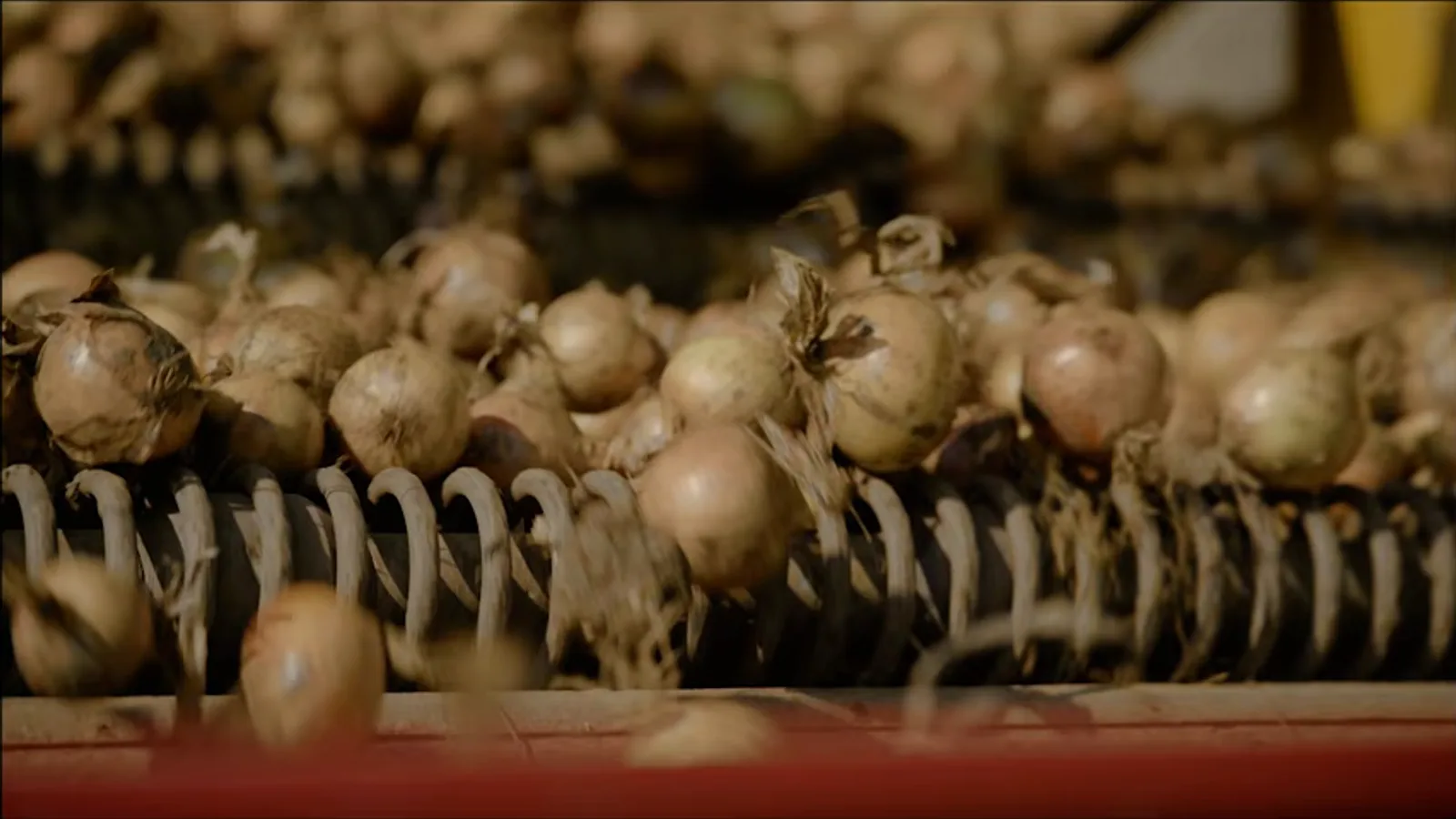
- On the sorter. The DOWNS CropVision optical sorter scans every bulb from every side and rejects defects, stones and soil clods, at up to 100 tonnes per hour.
- Before dispatch. We assess and document every batch once more, because that is the batch going out to the buyer with our name on it.
The most common mistake when assessing onions is checking only the top layer. Take your sample from several places in the batch and from different depths, and cut a few bulbs in half. The defect is almost always sitting deeper.
What this means for a wholesale buyer
A buyer taking onions by the tonne has no time to inspect every bulb. What counts is whether the supplier has a repeatable process, not a lucky year. Here that process is backed by the GlobalG.A.P. and GRASP certificates and by the principles of Integrated Plant Production, and every batch comes with its quality and size documented. We also produce free of pesticide residues.
Onions that are well assessed and well prepared also mean a longer buying horizon. We release produce from our store all year round, so a buyer can plan deliveries instead of buying under pressure. How that works in practice is in our guide to onion storage, and the full parameters of the produce are in the onion offer.
Looking for onions of consistent quality, with the batch documented and certified? Write to us through our contact page and we will prepare a quote and a free sample.