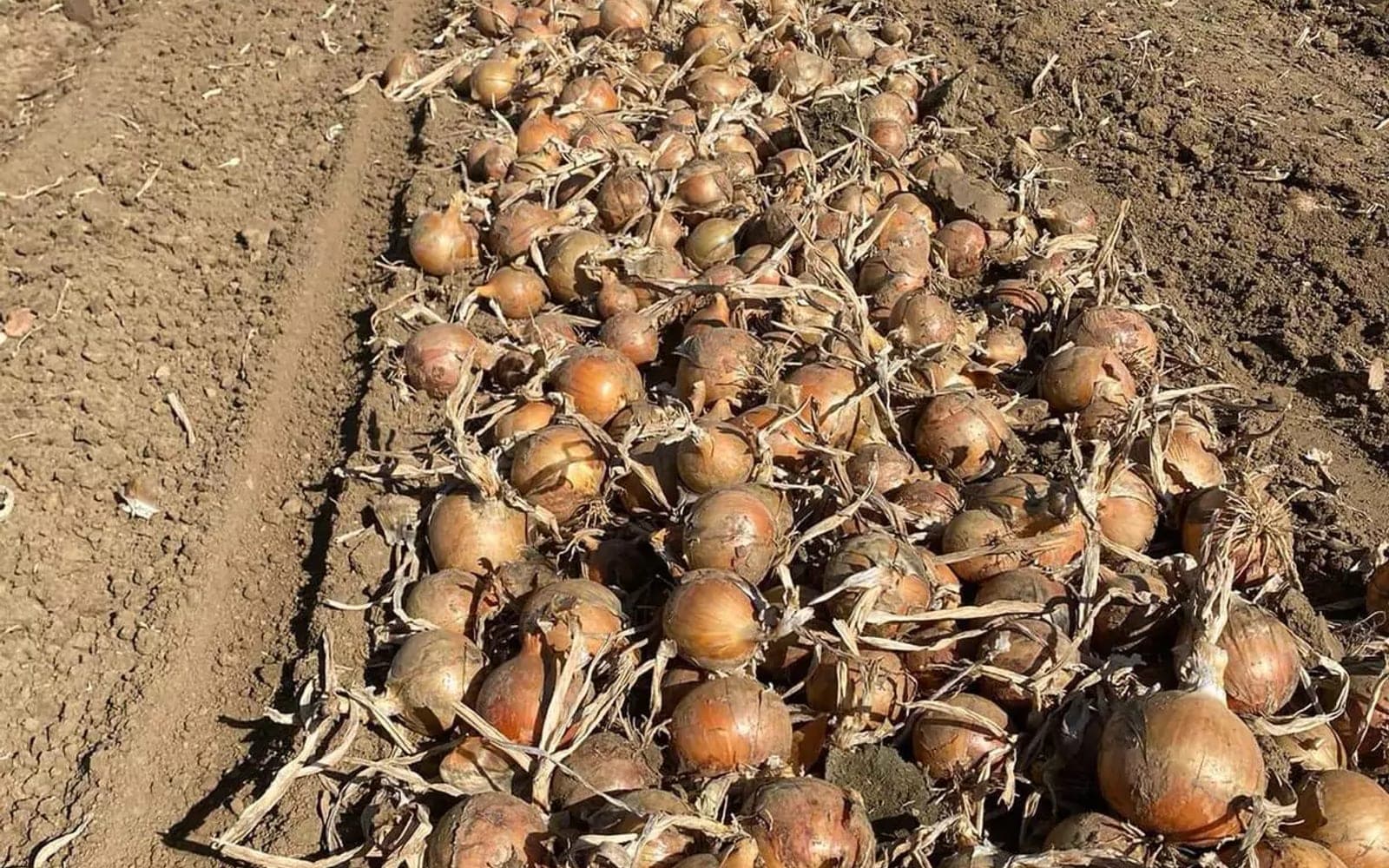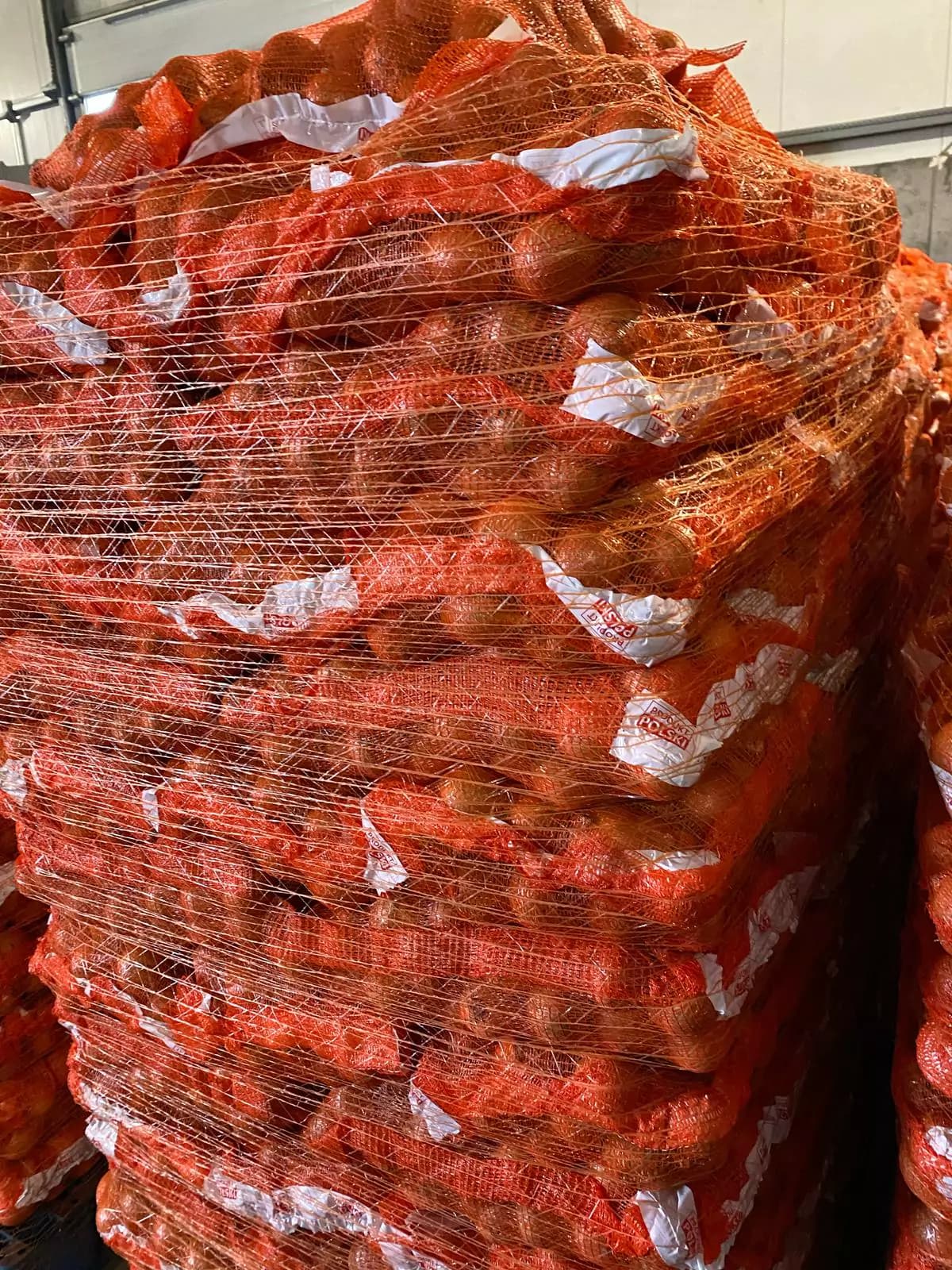
A standard trailer with a payload of around 24 tonnes net normally takes 24 big bags of about a tonne each, or 24 pallets of mesh sacks. What decides how much a truck really carries is weight, not space: you run out of permitted gross weight long before you run out of room in the trailer. In this post we show how we prepare an onion shipment, how we stack pallets and what travels with the produce.
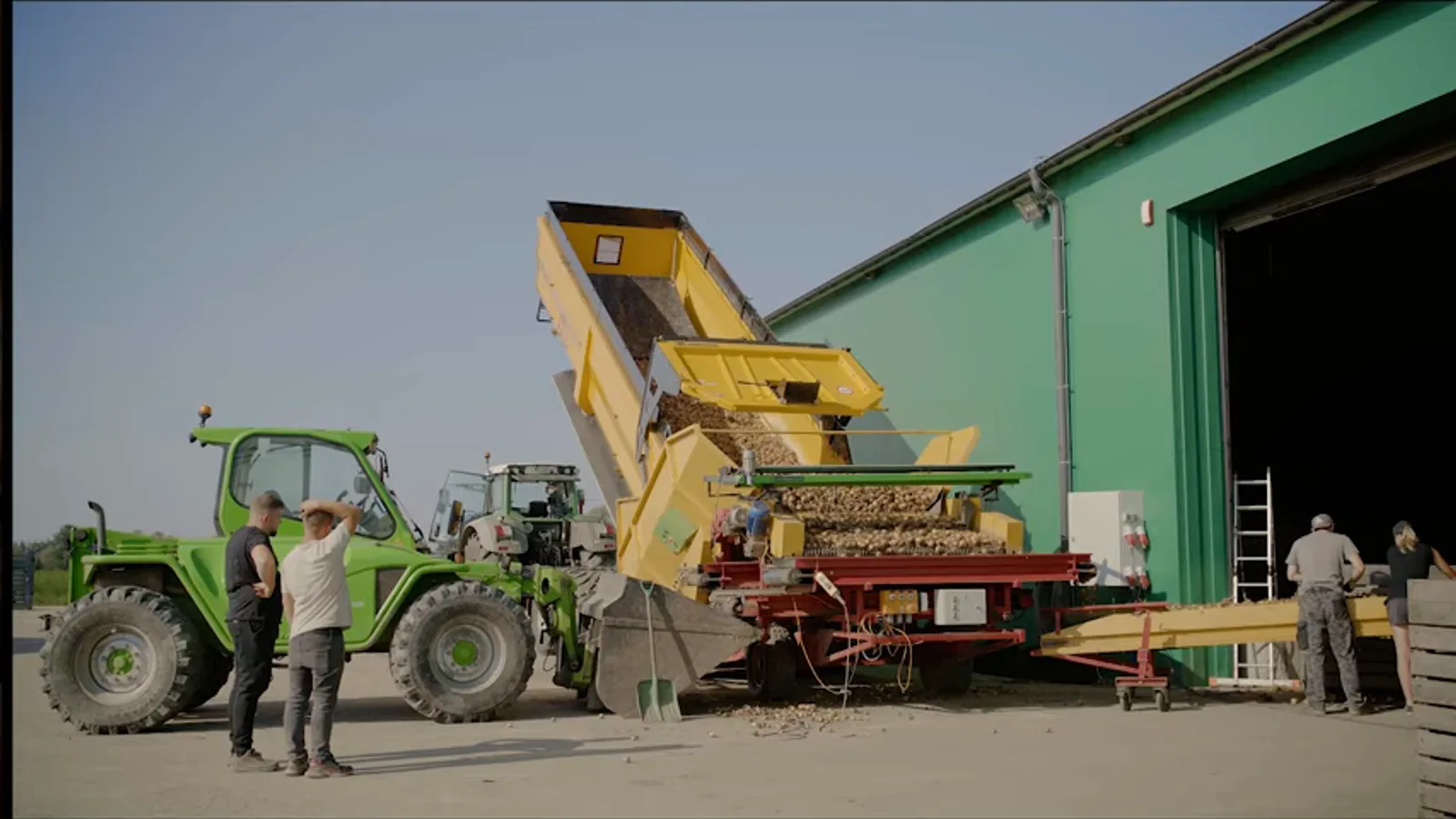
We ship onions from our own store for around 13,000 tonnes, packed on an automated line with a palletiser. We plan deliveries all year round, not only during the harvest season, so logistics here is daily work rather than an add on to selling.
How many onions fit on one truck
The starting point is a rig with a permitted gross weight of 40 tonnes, which carries around 24 tonnes of net load. A curtainside trailer is about 13.6 metres long and holds 33 euro pallets in a single layer, but with onions we never get near that number, because the tonnage runs out first.
| Form of shipment | Unit weight | How many on a trailer |
|---|---|---|
| Big bag on a pallet | approx. 1,000 kg | approx. 24 units |
| Pallet of 25 kg mesh sacks | approx. 1,000 kg (40 sacks) | approx. 24 pallets |
| Loose onions | continuous load | approx. 24 tonnes |
So the first question we ask with an order is this: how many tonnes and in what form. The rest, meaning the number of pallets and the way they are stacked, follows from that answer. We set out the whole course of an order in our guide to how to order onions wholesale.
Pallet, big bag or loose: what suits what
We match the form of shipment to the buyer and to what they will do with the produce next.
- Loose goes where onions head straight onto a processing line and there is no point packing them.
- Big bags are the standard in wholesale trade: one move of the forklift is close to a tonne of produce. We covered the sizes in our post on big bags.
- Mesh sacks we choose when the onions are headed closer to retail and need smaller units.
Whatever the form, one rule holds: the packaging has to breathe. Onions keep breathing and giving off moisture after harvest, so sealed film turns a pallet into a steam chamber. We use ventilated packaging only.
How we stack a pallet so the onions arrive healthy
A pallet is not just a way of lifting produce with a forklift. It is also a structure that has to survive a few hundred kilometres of road and not suffocate the onions on the way.
- The base. A clean, dry pallet, with no protruding nails and no cracked boards.
- The stack. We lay the sacks in an interlocking pattern, so the layers hold each other rather than sliding when the truck brakes.
- Ventilation. We leave a path for air: between the big bags and between the pallets in the trailer. Air needs somewhere to circulate.
- Securing. We stabilise the load without sealing the produce in. The aim is a stable pallet that still breathes.
- Labelling. Every pallet travels labelled: what it is, what size, which batch.
The most common mistake in onion transport is wrapping the pallet in film all the way up, the way you would wrap a carton. The produce starts sweating within hours and the buyer unloads wet sacks. With onions, an airtight wrap is the enemy, not a benefit.
The palletiser and preparing a shipment
We build the pallets with a palletiser, a machine that stacks filled sacks on the pallet in a repeatable pattern. Repeatability matters more here than speed: a pallet stacked by hand can end up crooked, and a crooked pallet leans in transit and bruises the produce.
Before the onions even reach a sack, they go through the sorter and grading, so what goes on the pallet is even produce. We described that whole route in our post on the onion packing line and palletiser. The equipment we use for it is also in our machinery park.
What travels with the produce
A B2B delivery is not just onions on a trailer. Along with the batch we prepare the full set of information the buyer's warehouse and quality team need.
| Item | What it is for |
|---|---|
| Batch specification | size, variety, form of packaging, weight |
| Batch marking | links the produce to a specific harvest and store |
| Delivery note | the basis for taking the produce in at the buyer's warehouse |
| Certificates | GlobalG.A.P., GRASP, confirmation of Integrated Plant Production |
| Test results | residue analyses, where the buyer requires them |
This set shortens unloading and cuts complaints, because the buyer's warehouse knows straight away what it is taking in. How we control every batch we cover separately in our piece on quality control batch by batch.
Temperature, time and unloading
Onions are not produce that needs refrigerated transport, but they cannot stand two things: swings in temperature and moisture. So we release produce from the store cooled and dry, and we load trucks so they do not stand in the sun for no reason. On longer routes it matters all the more that the batch was properly cured beforehand.
On the buyer's side, what counts most is the facilities: a forklift with enough lifting capacity for big bags and room for pallets. We always agree the form of shipment around the unloading capabilities of the specific warehouse, because the best packed pallet is worth little if there is nothing to lift it off with.
Deliveries all year round, not just after harvest
Our biggest logistical advantage comes from the store. It lets us release produce to the buyer's rhythm rather than the weather's, and lets us agree a standing schedule: so many tonnes a week or a month. How we steer that in practice is in our piece on selling from the store.
Our onions go to packing houses and processing plants, including partners such as Onix, Farm Frites and FreshPol, who supply the largest retail chains and processing plants in Poland and Europe. At that scale a delivery has to be predictable to the day and to the tonne. We have gathered the terms of wholesale cooperation in our guide to onions in wholesale.
Planning regular onion deliveries and want to know the terms? Write to us through our contact page or see the full onion offer.