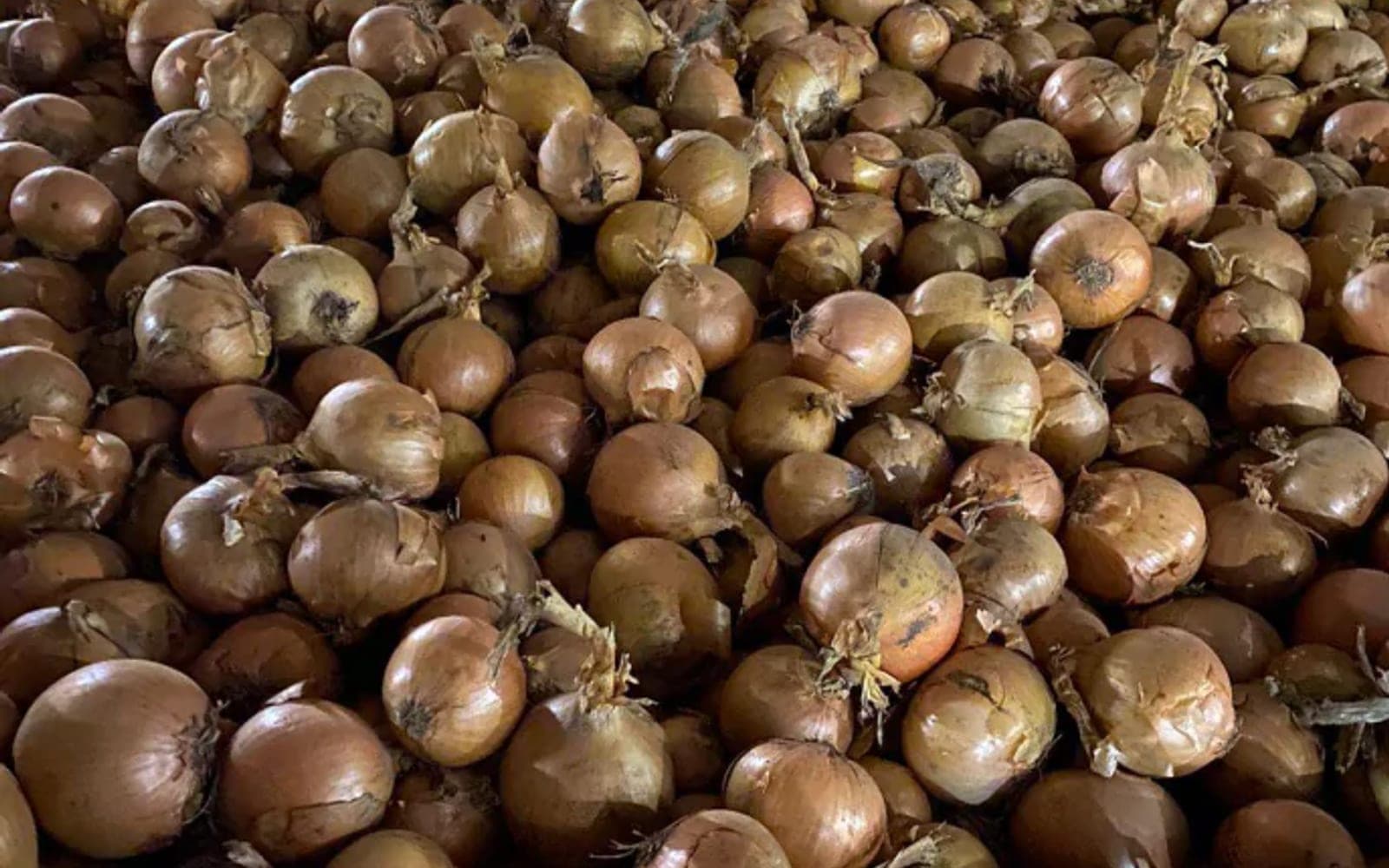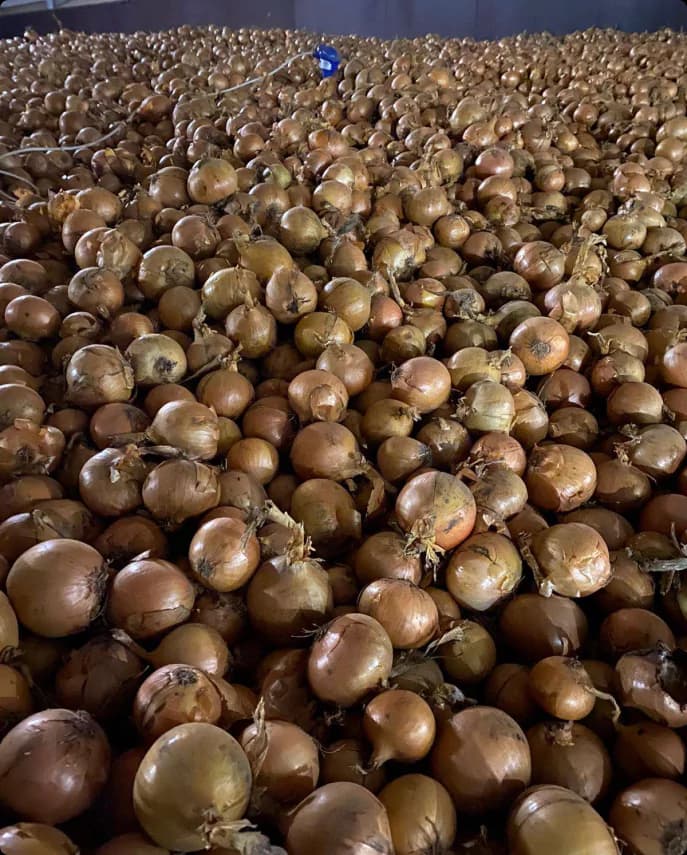
We sort stored onions before dispatch on the DOWNS CropVision optical sorter. Cameras and AI scan every piece in 360 degrees and reject stones, soil clods and defective pieces, up to 100 tonnes per hour. After months in storage, a batch can contain sprouts, mould, soft pieces and cracked skin, so below we show what happens to onions between the chamber and the truck, and how you can assess a batch yourself.
What can appear in onions during storage
We keep our onions in our own 13,000-tonne storage facility. After harvest we cure them for 2 to 4 days, and controlled ventilation and curing keep the skin dry and the onions healthy for many months. Still, onions are a living product. They lie there, they breathe, and after months in storage some of them can show one of four things.
| What appears | How to recognise it | Where to look in the sample |
|---|---|---|
| Sprouts | a green tip coming out of the neck or a green centre in the cross-section | neck, lengthwise cut |
| Mould | black, blue-green or grey growth on or under the skin | near the neck, between the skins, on the base |
| Soft pieces | the onion gives under your thumb, the neck is soft or damp | the whole piece, neck |
| Cracked skin | the skin is cracked, comes off in flakes and exposes a paler layer | sides and base of the piece |
Three of these have their own posts on our blog. Where sprouts come from, we describe in our post on onion sprouting in storage. How to tell the mould colours apart, we show in our post on mould on onions. Why the skin cracks and falls off, we explain in our post on how we look after onion skin.
Here we focus on the last step: what we do before a batch leaves the farm.
What we do with onions before loading
Before onions leave, they go through the optical sorter, batch selection and the packing line.
DOWNS CropVision optical sorter
We use it to sort onions, potatoes and red beets. Industrial cameras and artificial intelligence scan the entire surface of every piece, in full 360 degrees. So the camera also sees the base and the sides of the onion, not just what faces up on the belt.
The machine rejects stones, soil clods and defective pieces. It handles up to 100 tonnes per hour, so large batches go through quickly, and the buyer gets even, clean produce.
Batch selection
We run constant quality control. We select every batch for firmness, colour and dry skin. After months in storage, these three features tell you the most: a soft piece stands out by its firmness, and skin that comes off in flakes no longer covers the onion well.
We also test every batch for pesticide residues, heavy metals and substances hazardous to health. We produce using pesticide-residue-free technology, in line with the principles of Integrated Plant Production.
Packing line and palletiser
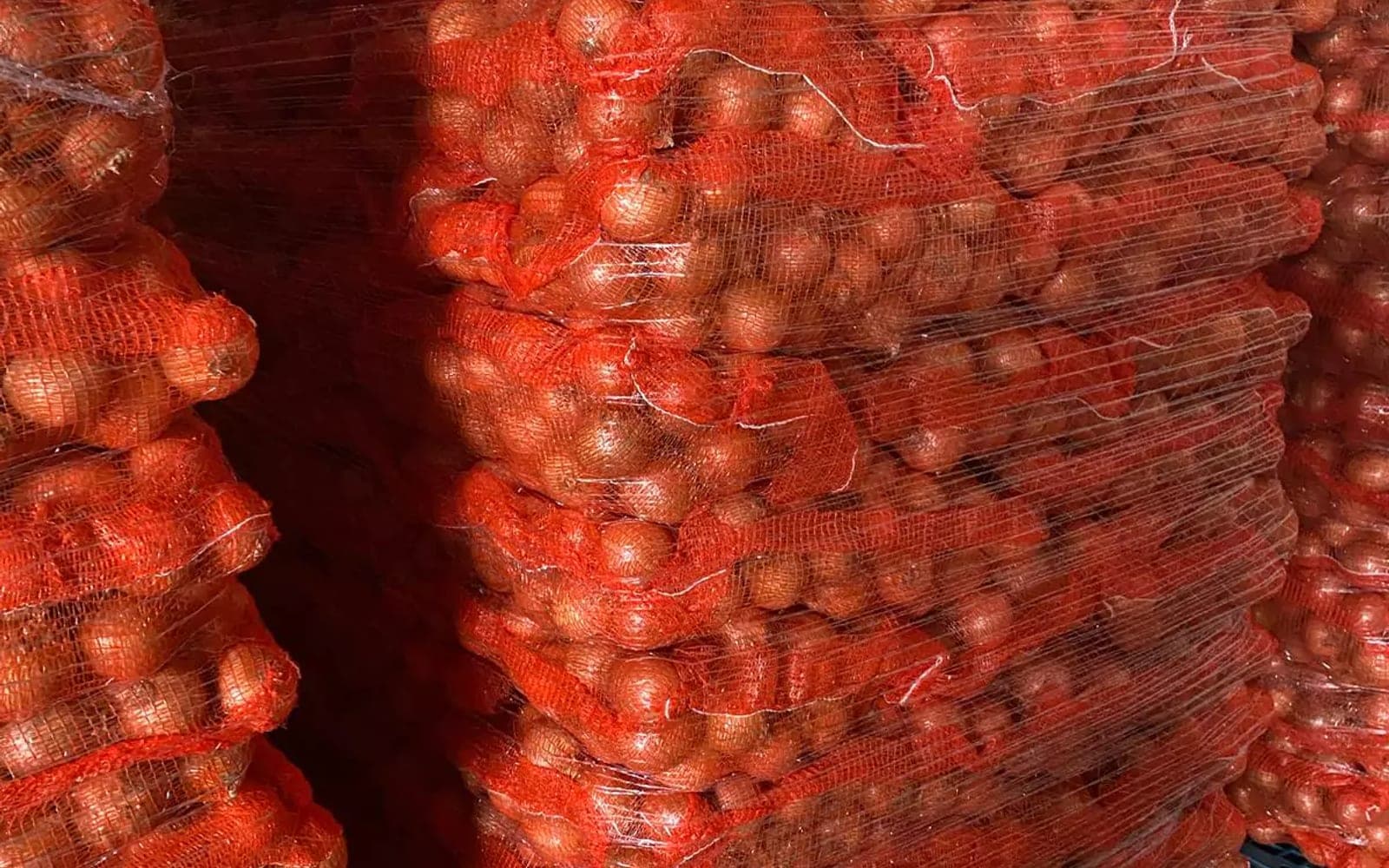
We pack the sorted onions on an automated line, and a palletiser stacks the finished packs. We pack loose, in big bags or in 15 kg, 10 kg and smaller sacks. We match the size and the packing form to what the buyer needs.
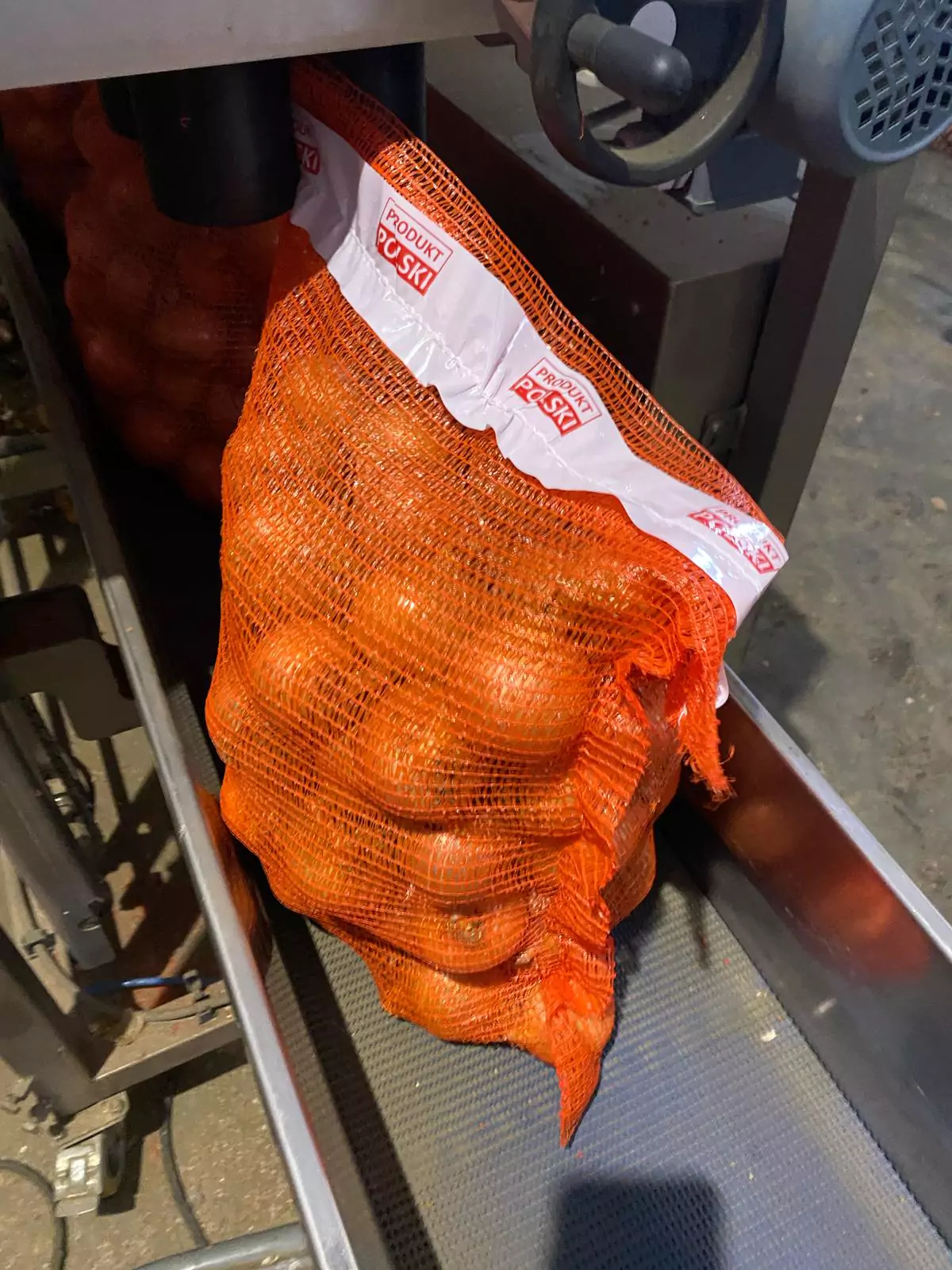
Why this matters for large batches
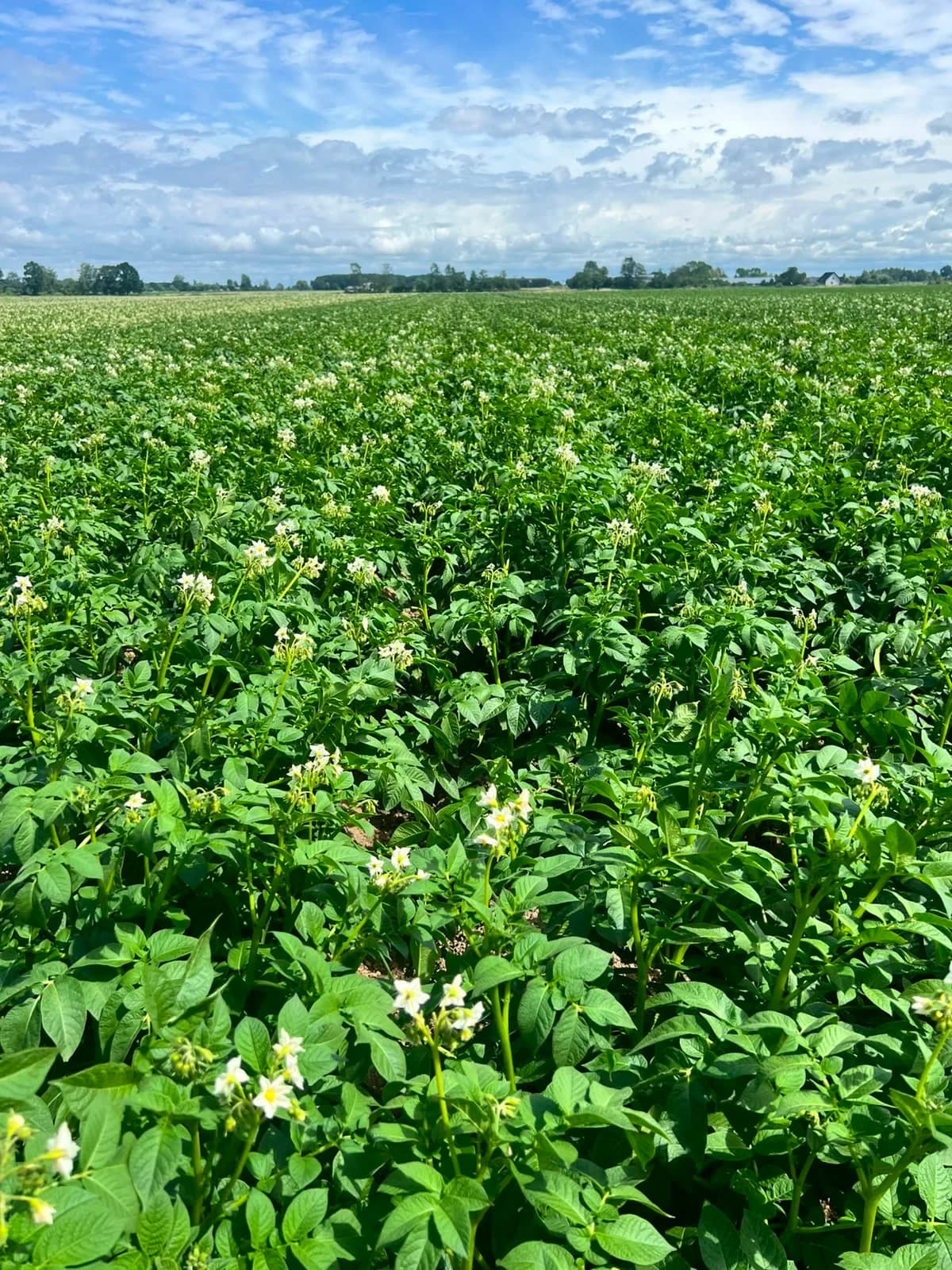
We grow onions on around 250 ha, with yields of around 60 t/ha. Onions are a rarity in Żuławy, and our produce goes in bulk to packing houses and processing plants in Poland and Europe. Our own 13,000-tonne storage facility lets us spread sales over time and release onions all year round, not just after harvest.
The longer onions lie in storage, the more it matters what happens just before loading. That is why, for us, the sorter and selection are not a formality but the last sieve before the loading ramp.
Our vegetables go to market leaders such as Onix, Farm Frites and FreshPol, partners who supply the largest retail chains and processing plants in Poland and Europe. More on how onions keep until spring in our guide to onion storage.
How to assess a batch of stored onions, step by step
The best test of sorting is your own assessment. Here is how you can do it on a sample.
- Ask us for a free sample. We send one on request.
- Lay the onions out in good light and look at each piece from all sides, including the base. Set aside the pieces with mould, with cracked or peeling skin and with a visible sprout.
- Squeeze each onion in your hand and touch the neck. A healthy piece is firm, and the neck is dry.
- Cut a few onions lengthwise, through the neck. A green centre shows a sprout that has not yet come out, and dark or softened layers show a problem inside.
- Weigh each group you set aside and work out its share of the sample weight.
- Compare the result with the specification in your contract or with your own purchasing requirements.
In this post we do not give thresholds for how many defective pieces a batch may contain. Take the limits from your own specification. We provide a sample you can assess on your own premises before you place an order.
Varieties, documents and ordering
For yellow onions, we mostly rely on the varieties Hybelle, Hysinger, Hyfive, Nation, Revelation and Bingo. These are firm, well-skinned Rijnsburger-type onions that cope well with long storage. For red onions, we grow Redtide, Redmate, Aurelion and Tannat. We hold GlobalG.A.P., GRASP, FSA Gold (Farm Sustainability Assessment) and GMP+ certificates, and we run the farm based on the principles of Integrated Plant Production.
Varieties, packing forms and availability are gathered in our offer of yellow onions from Żuławy. The price is calculated based on current market prices, so we give it after we talk about volume, timing and delivery form. Write to us via the contact form, and we will get back to you with availability, sizing and price.