The colour of the growth and the place it starts are the first clue to which mould is on an onion: black mould (Aspergillus niger) leaves a black, sooty mass (UC IPM), Penicillium a green to blue-green growth (UC IPM), and Botrytis a grey, felty growth on rotting scales, with symptoms usually starting at the neck (UC IPM). The surface alone is not enough, because infection can sit under the skin, so when you receive a batch, the cross-section is what counts. Below we give a table for the person receiving the goods and answer whether mould can be cut away.
Table: growth colour, possible cause and what it means for the batch
Read it from the left: first the colour on the surface, then the cross-section. We take the symptom descriptions from UC IPM, the University of California's plant protection programme.
| Growth | Possible cause | Where to look on the cross-section | What it means for the batch | Separate post |
|---|---|---|---|---|
| Black, sooty | Aspergillus niger (UC IPM) | neck and outer skins, also between the dry skin and the first fleshy scale | count growth on dry skin and bulbs with a discoloured centre separately | onion black mould |
| Green to blue-green, powdery | fungi of the genus Penicillium (UC IPM) | spots on the outer surface of the scales, infected fleshy scales tan or grey | look for wounds and bruises, because that is usually where the fungus gets in | onion blue mould |
| Grey, felty | Botrytis allii and Botrytis aclada (UC IPM) | from the neck: tissue softens, turns water-soaked and browns | infection starts in the field, so squeeze the necks of bulbs without growth too | onion neck rot |
| White, not always visible | Fusarium oxysporum and Fusarium proliferatum (UC IPM), possibly also white rot, or Stromatinia cepivora (UC IPM) | bottom of the bulb: with Fusarium basal rot, brown discolouration of the basal plate on a vertical cut | cut vertically through the basal plate, because there may be no growth | onion Fusarium basal rot |
A grey colour inside settles nothing on its own. According to UC IPM, black mould can cause grey-black discolouration inside with no symptoms on the outside. Fleshy scales infected by Penicillium are, according to UC IPM, tan or grey when cut. So the colour inside is only a clue: compare it with the growth and the place it starts, if they are visible.
Black, blue, grey: how to tell them apart
Black growth. According to UC IPM, black mould is primarily a post-harvest disease, and it needs moisture on the onion for 6-12 hours to develop. It appears, as UC IPM reports, where injury, disease or collapsed leaves have opened the skin.
Blue growth. According to UC IPM, the fungus usually gets in through wounds, bruises or a neck that has not dried properly. The disease appears, according to UC IPM, at harvest and in storage.
Grey growth. According to UC IPM, Botrytis infection starts in the field, and in onions the disease usually shows only in storage. In humid air, according to UC IPM, a grey, felty growth appears on the rotting scales. Dark brown to black sclerotia can later form in the neck or between the scales (UC IPM). These are the fungus's resting structures. Do not confuse them with the sooty growth of black mould.
White mycelium at the basal plate. It can point to Fusarium basal rot, but white rot also leaves a similar fluffy growth at the base of the bulb (UC IPM). With Fusarium basal rot, according to UC IPM, white growth on the bottom of the bulb shows only sometimes, and a vertical cut reveals brown discolouration of the basal plate.
How to assess a batch with growth, step by step
- Take a sample from several points in the batch, not just the top of a pallet, bag or big bag.
- Note the colour of the growth and the place it starts: neck, side or basal plate.
- Squeeze the neck and side of every bulb. A soft spot is a signal to look at it more closely.
- Cut some of the bulbs vertically, through the neck and basal plate, and compare them with the table above.
- Count three groups separately: growth on the dry skin only, infected fleshy scales, soft or wet bulbs.
- Take photographs of the cross-sections with the batch marking.
We do not give percentage thresholds here.
Can mould on an onion be cut away?
We have no certain answer for onions specifically.
A UConn Extension publication recommends that for firm vegetables, such as cabbage, peppers or carrots, you cut away at least an inch, or around 2.5 cm, around and below the mouldy spot. Soft fruit and vegetables with mould, UConn Extension says to throw out whole. The publication does not mention onions, so this is only an inference by analogy. An onion has layers, and according to UC IPM, black mould spores can develop between the dry skins and the first fleshy scale.
So we make no promises based on the knife alone. Cut an onion with growth open first. If the growth or discolouration reaches the fleshy scales, or the onion has gone soft, it is better to throw it out. This is cautious guidance, not an official recommendation or a guarantee of safety.
There is also the question of mycotoxins. According to the WHO, these are toxic compounds produced by some moulds, and ochratoxin A is produced by several species of Aspergillus and Penicillium. The WHO also states that most mycotoxins are chemically stable and survive food processing. That page does not address onions themselves, so we do not know how much a particular bulb might contain. We would not count on peeling or processing to save bulbs with infected fleshy scales.
What we do before onions head your way
The descriptions above point to one thing: wounds and moisture help the fungi. So we watch both:
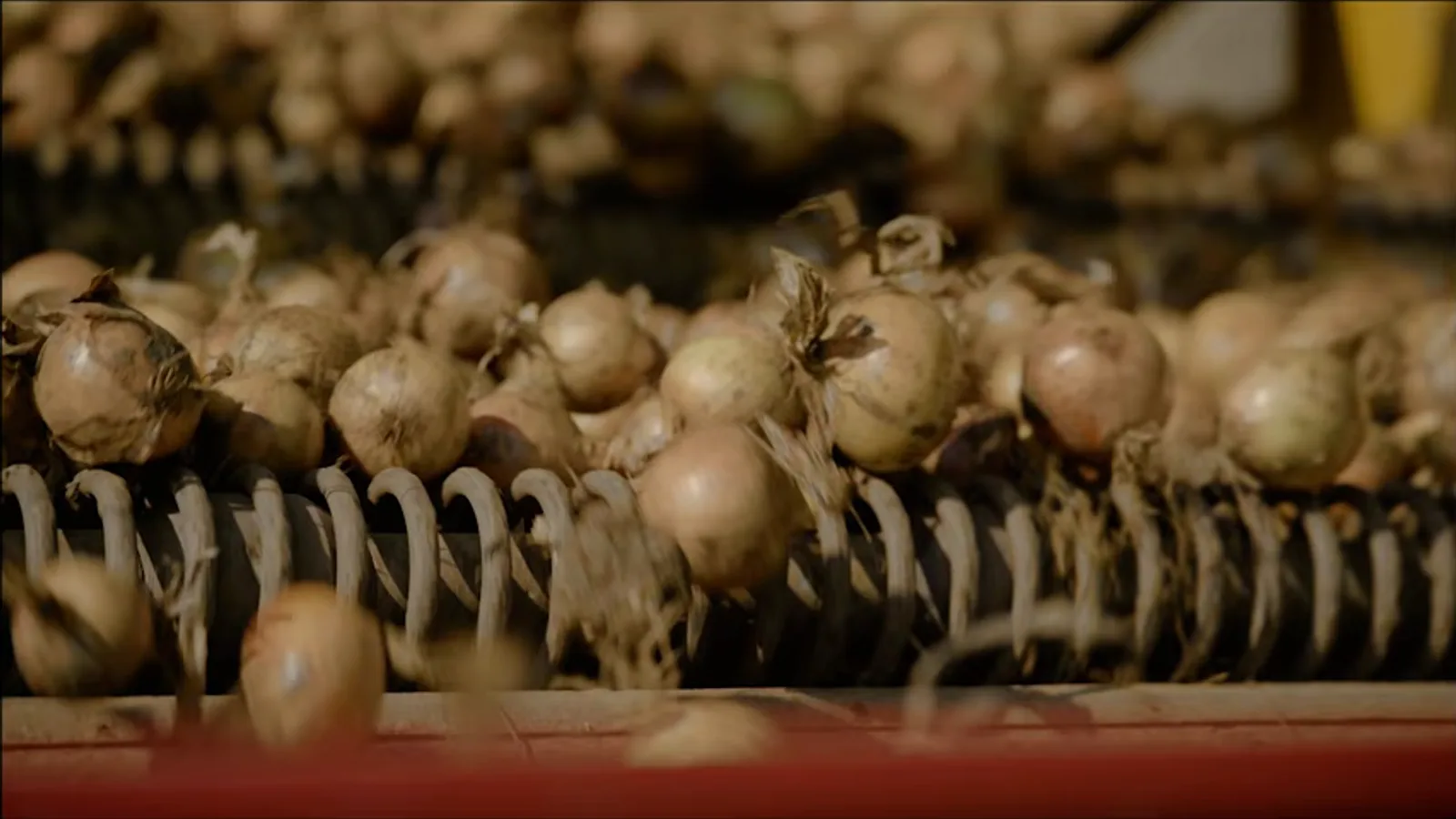
- We harvest gently on the skin. Our self-propelled AVR Puma 3 harvester brings in the onions.
- We cure for 2-4 days. Controlled ventilation and curing keep the skin dry.
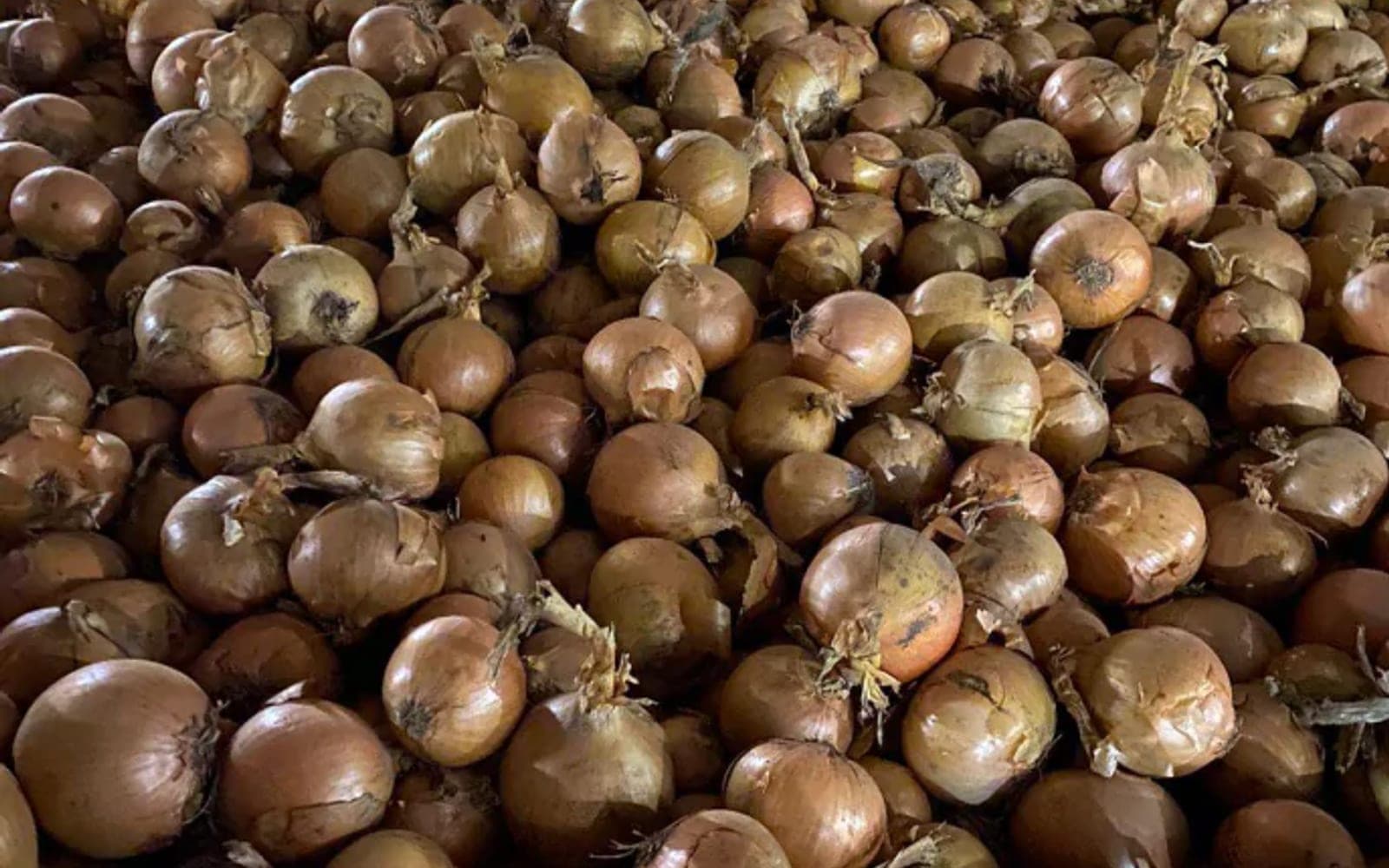
- We keep onions in our own 13 000 tonne store. We select every batch for firmness, colour and dry skin.
- We sort before shipping. On the DOWNS CropVision, cameras and AI scan the surface of every bulb through 360 degrees and reject defective bulbs, at up to 100 tonnes per hour.
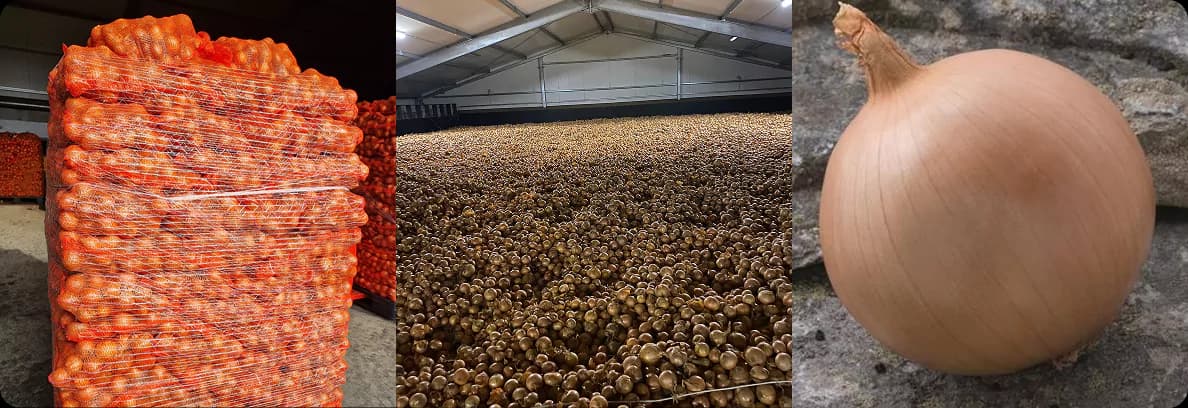
The sorter looks at the surface, not the cross-section, so we do not promise it will catch every infection under the skin. A cross-section on receipt makes sense with our onions too.
After delivery, conditions are in your hands. According to UC IPM, large temperature swings can cause water to condense on the onions, which favours Botrytis. We describe temperature, humidity and ventilation in our guide to onion storage.
Check our onions on a sample
We grow around 250 ha of onions in Żuławy and answer for them at every stage, from the field through the store to packing. On request we send a free sample, so you can cut it open and compare it with the table before your first order. Details are on the yellow onions from Żuławy page. We calculate the price based on current market rates, and the simplest way to send an enquiry is through the contact form.