Onion black mould is a disease caused by the fungus Aspergillus niger, which leaves a black, powdery growth at the neck and under the outer skins. Onions usually pick it up in the field and at harvest, and the disease develops in warmth and moisture. What decides a batch's fate, then, is how quickly the onion dries and cools down after harvest. Below we describe how to recognise black mould, what favours it, how we prevent it and how to assess a mouldy batch on receipt.
How to recognise black mould on an onion
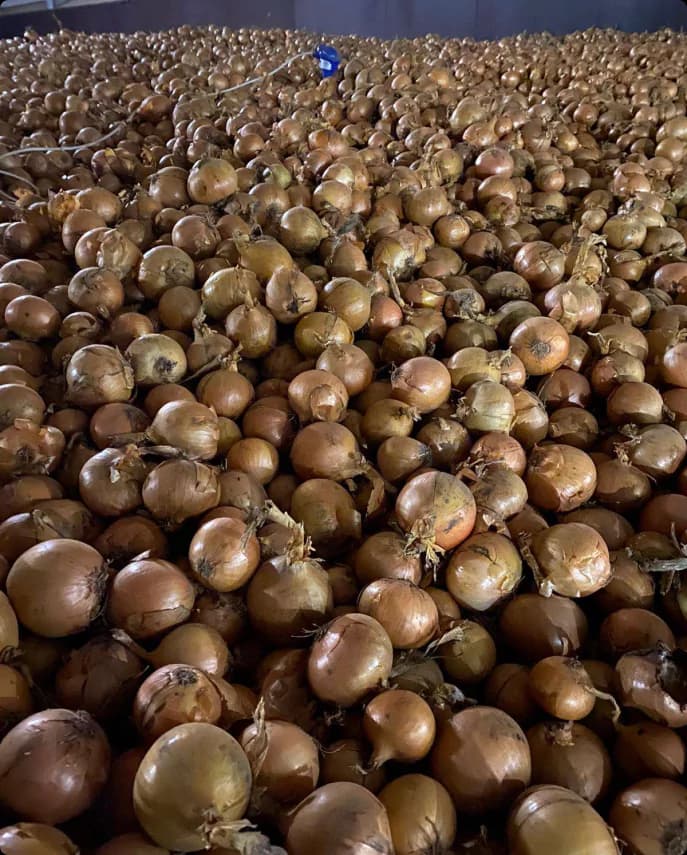
The most telling sign is black, soot-like clusters of spores. They appear at the neck and on the outer, dry skins, often in streaks along the skin's veins. Affected skins look water-soaked at first. Sometimes the inside of the onion is already discoloured, even though nothing shows from the outside.
At an advanced stage, the fungus moves down into the fleshy scales, and secondary wet bacterial rot takes over the onion. A bulb like that goes soft and stops being sellable.
Black mould is easy to confuse with other storage diseases. The simplest way to tell them apart is by the colour of the growth and where the problem starts:
| Disease | Cause | What you see | Where it starts |
|---|---|---|---|
| Black mould | Aspergillus niger | black, powdery growth in streaks under the dry skin | neck and outer skins |
| Neck rot | a fungus of the genus Botrytis | softening from the neck, grey mould under the skin | neck, top to bottom |
| Fusarium basal rot | Fusarium oxysporum f. sp. cepae and Fusarium proliferatum | rot from the base, white mycelium on the basal plate | basal plate, bottom to top |
We write about the other two diseases separately in our posts on onion neck rot and onion fusarium basal rot.
Where black mould comes from
Aspergillus niger lives on plant debris and in the soil, and its spores travel on the air. It is a weak pathogen: it usually does not attack healthy, undamaged onions. It gets in through wounds, bruises and the neck while the leaves are drying down.
To develop, it needs two things at once:
- Warmth. It grows best at 28-34°C. According to Purdue University's extension service, the disease shows up most often when the temperature in the field goes above 30°C, or above 24°C in storage.
- Water on the surface of the onion. According to the University of California's IPM programme (UC IPM), an onion has to stay wet for at least 6-12 hours for infection to take hold.
That gives the typical scenario: a hot harvest, onions bruised during loading, and then temperature swings that cause water to condense on the skin and between the layers. The USDA's storage handbook (Agriculture Handbook 66) states this directly: infection usually starts in the field, and after harvest the disease can spread from onion to onion, which is why the surface of the onion has to be dry during and after harvest. We explain where water on a cold onion comes from in our post on why onions sweat.
How we prevent black mould
Protection against black mould rests on growing practice and post-harvest conditions, not on chemicals. We grow onions under the principles of Integrated Plant Production, so above all we make sure the fungus gets neither a wound nor water.
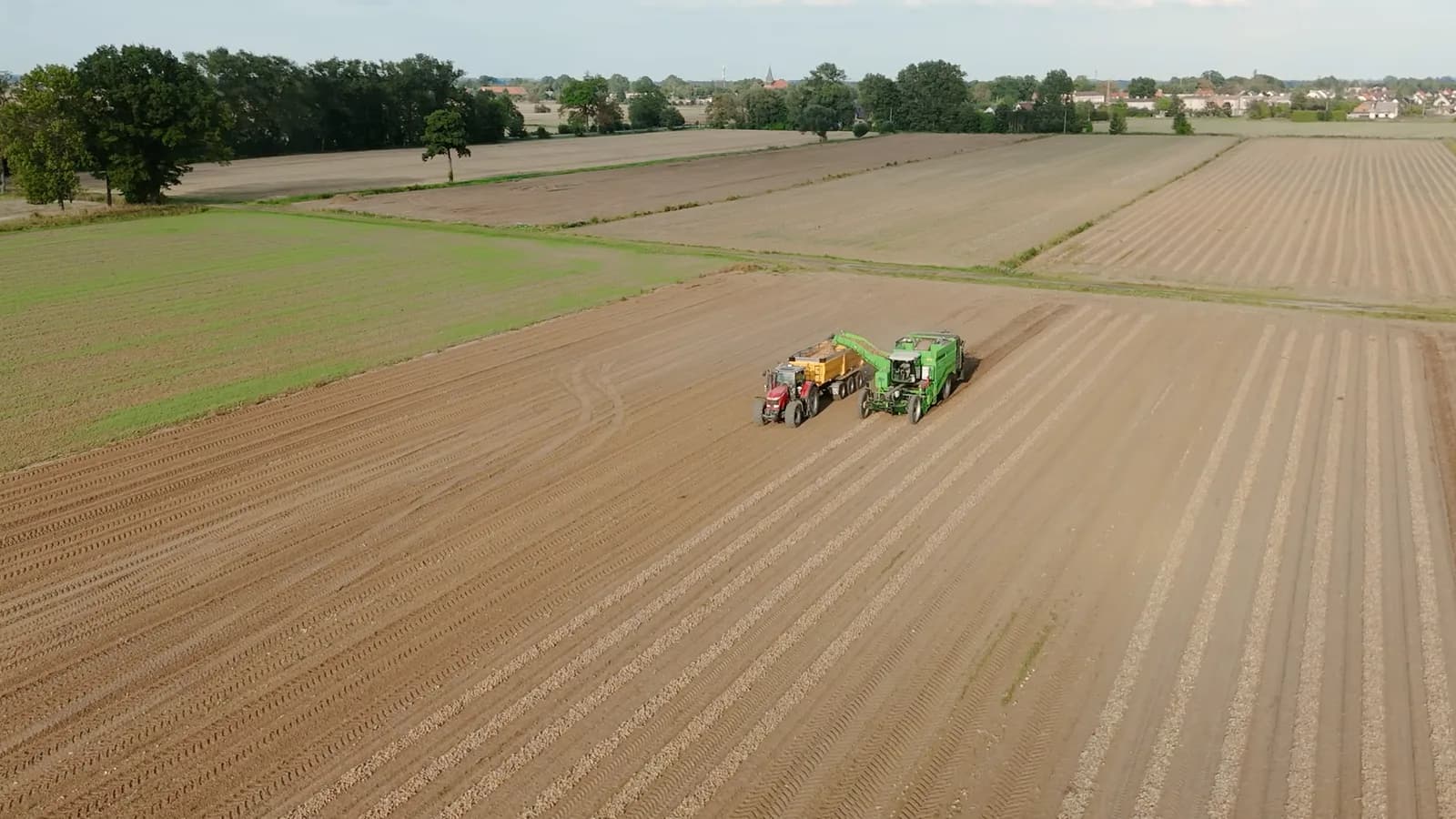
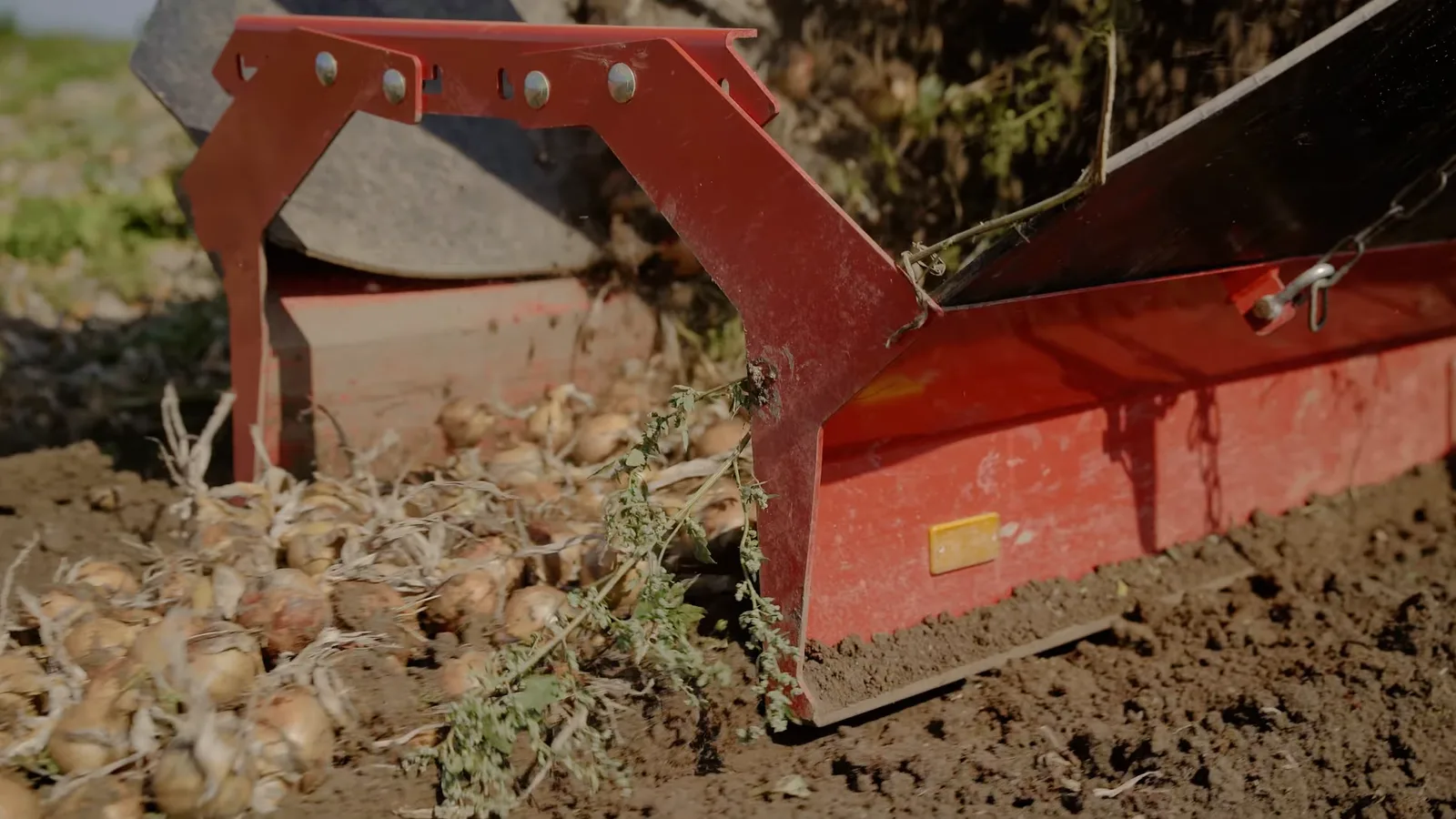
- We harvest in two stages. A Grimme WV 180 windrower undercuts the onions and lays them in windrows to cure, and a self-propelled AVR Puma 3 harvester picks them up from the windrows. The neck has time to close before the onion reaches the trailer. We describe how we limit bruising in our post on mechanical damage at harvest.
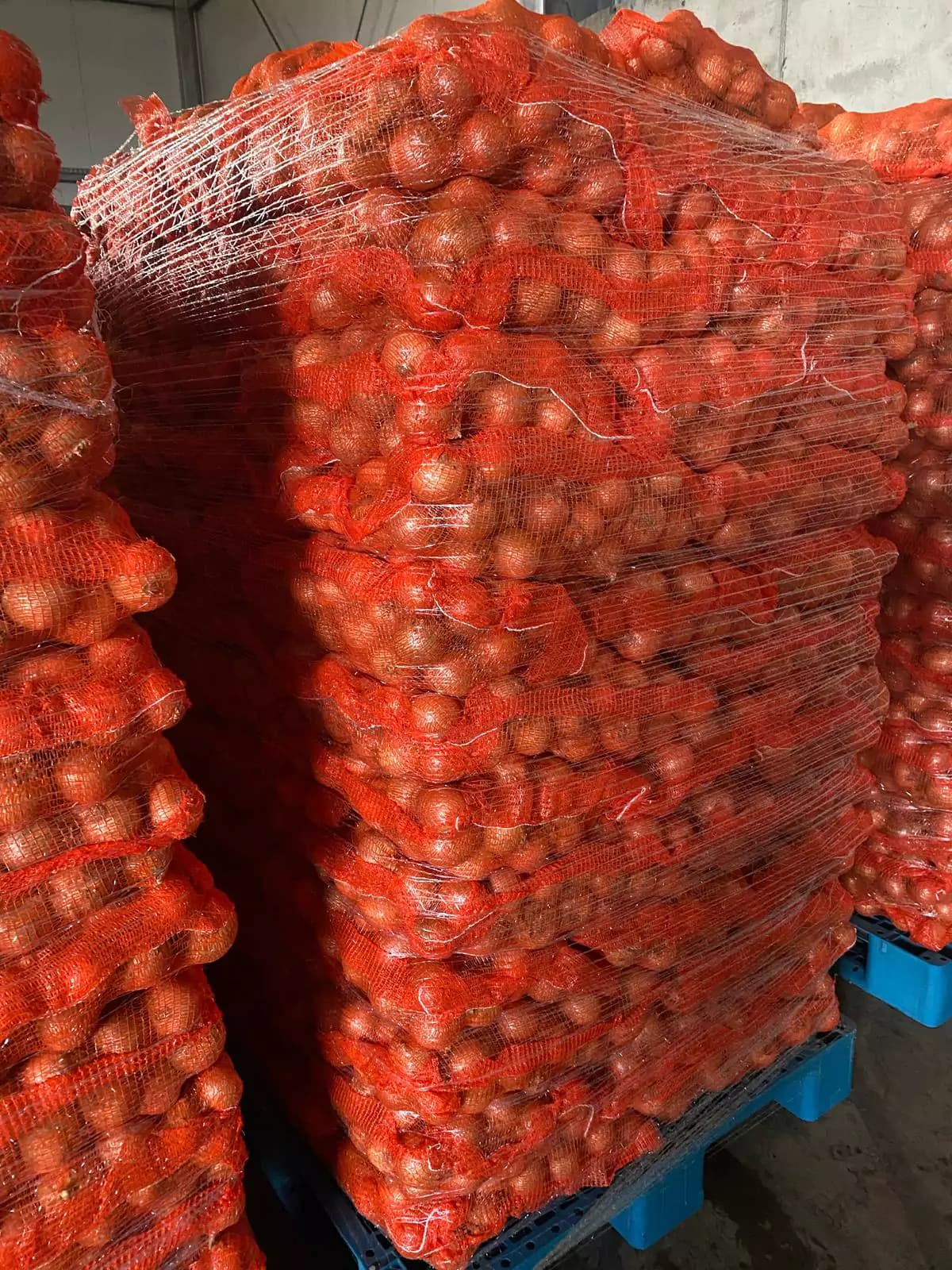
- We cure for 2-4 days. Airflow through the pile draws water off the surface of the onion and closes the neck. That is how we take away the moisture the fungus needs to infect. Details in our post on curing onions.
- We cool and hold a stable temperature. Below around 15°C, black mould practically stops developing, and cool storage at moderate humidity slows its spread. In our 13 000 tonne store, we make sure the temperature does not swing, because every swing is a risk of dew on the skin.
- We sort optically. The DOWNS CropVision optical sorter scans onions at 360 degrees and rejects bulbs with visible defects. Growth hidden under dry skin is not always visible from the outside, which is why quality control of a batch does not end at the sorter.
Cold stops black mould, but it does not kill it. If onions from an affected batch reach a warm, humid warehouse, the fungus starts again. That is why conditions after delivery matter just as much as our own conditions.
How to assess a mouldy batch on receipt
Neither the UNECE FFV-25 standard nor the EU general marketing standard name black mould specifically. It is assessed through the minimum requirements: onions have to be sound and clean, and produce showing signs of rotting or deterioration that make it unfit for consumption is excluded. In Class I, the UNECE standard allows at most 1 percent of bulbs that are rotten or fail the minimum requirements; in Class II, at most 2 percent. We write more about the classes and tolerances in our post on onion quality classes.
In practice, what matters is how deep the growth reaches. It is worth cutting a share of the bulbs from the sample and assessing them like this:
| What you see in the sample | How to read it | What to do |
|---|---|---|
| A few black streaks on the outer, dry skin; fleshy scales clean and firm | a visual defect, not deterioration | count the share in the sample and check it against the class in the order |
| Growth under successive skins, fleshy scales discoloured | infection is progressing | set those bulbs aside and report them to the supplier with a description of the scale |
| The onion is soft, wet and has an unpleasant smell | secondary bacterial rot | count it as a rotten bulb, within the tolerance for rot |
| Growth appeared after a few days in the receiver's warehouse | warmth and condensation after delivery | check the warehouse's temperature and humidity |
If the scale of the growth exceeds the tolerance, it is worth filing a complaint straight away, with photographs of the cross-sections and the batch marking. We describe how to do that and how we handle it in our post on vegetable batch complaints.
Can an onion with black growth be eaten?
Some strains of Aspergillus niger can produce mycotoxins under laboratory conditions: fumonisins and ochratoxin A. There is very little data on their levels in onions themselves. In one study of 40 onion samples from Saudi Arabia, fumonisin B2 was detected in 37.5 percent of samples, and ochratoxin was not detected.
We have not found official guidance that addresses onions directly. The US food safety agency, USDA FSIS, gives a general rule for firm vegetables with dense flesh, such as cabbage or peppers: cut away at least 2.5 cm around and below the mould, and discard soft, moist produce whole. FSIS does not address onions, and an onion is built of layers the fungus can travel between more deeply, so this is only an inference by analogy.
Because infection can be invisible from the outside, it is worth cutting open an onion with visible growth. If the growth is only on the dry skin, and the fleshy scales underneath are clean and firm, we peel off the affected skins with a margin. If the growth or discolouration reaches the fleshy scales, or the onion has gone soft, it is better to throw it out.
Onions from Żuławy, straight from the grower
We grow around 250 ha of onions in Żuławy, harvest them with our own machines, cure them and store them in our own facility. That means we know the conditions every batch was held under before it reaches you. We describe how we grow, from sowing to harvest, in our guide onions from Żuławy: how we grow them. For our offer, take a look at onions from Żuławy, and send your enquiry through the contact form. We calculate the price based on current market rates.