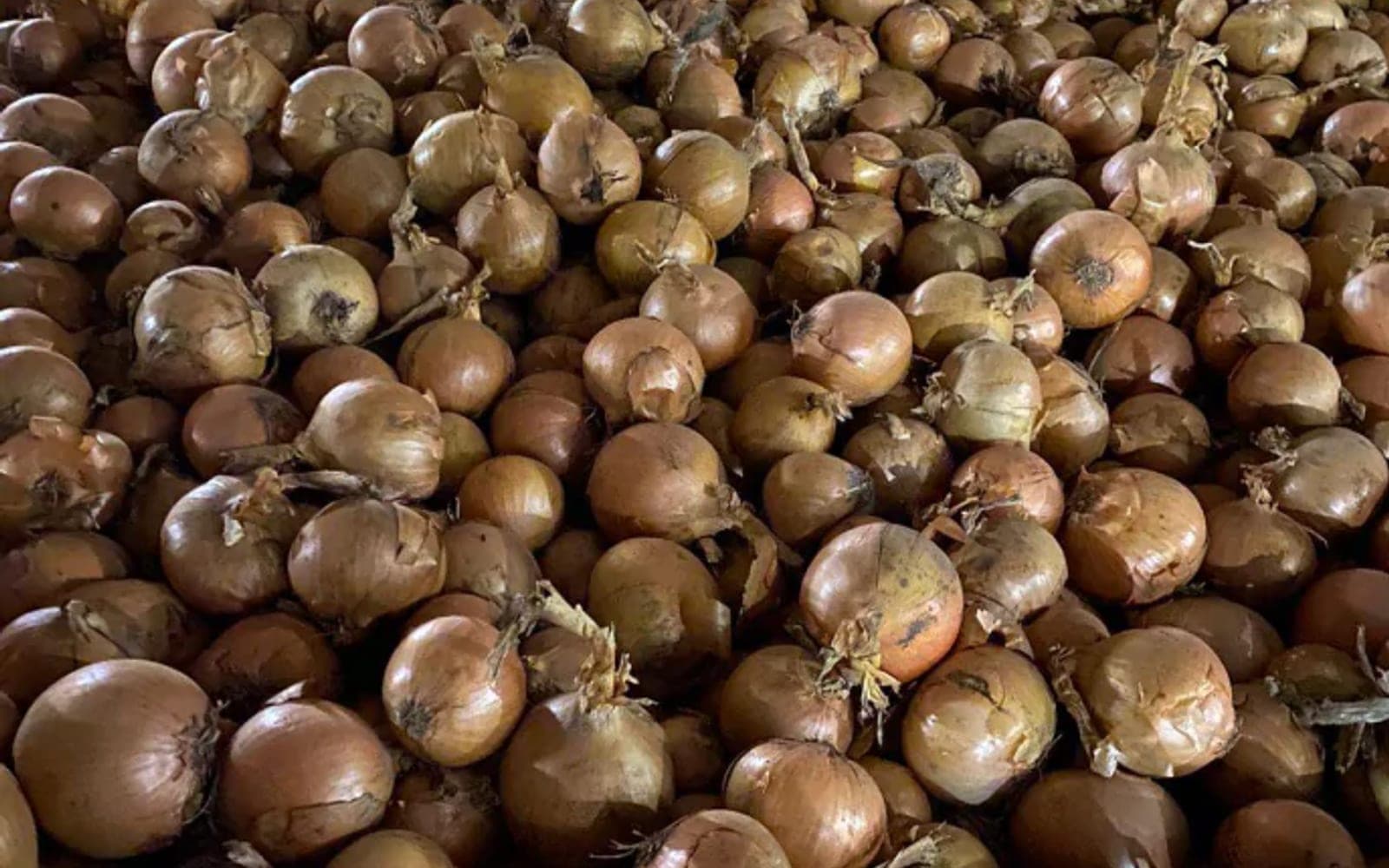
Fusarium basal rot is a fungal disease that attacks onions from the bottom: from the roots and the basal plate upwards. Infection starts in the field, usually in warm soil, and symptoms often show only after a few weeks in storage, in a batch that looked healthy. Below we describe how to recognise it, what favours it and what we do to limit the losses.
What Fusarium basal rot is
The classic culprit, described in the integrated onion protection guidelines of the Polish National Institute of Horticultural Research (IO), is the fungus Fusarium oxysporum f. sp. cepae. It overwinters in the soil as resting spores called chlamydospores, and also on crop debris, on infected onions in storage and on onion sets. It enters the plant through the roots and the basal plate, most easily through wounds: after onion fly feeding, after mechanical damage and through root scars.
The second recognised culprit is Fusarium proliferatum. In some studies from northern and eastern Europe it was the dominant fungus isolated from stored onions. The symptoms of the two are similar: both species spoil the onion from below and both like warmth.
Fusarium basal rot is one of the three diseases that most often spoil onions in storage. We cover the other two, neck rot and bacterial soft rot, in our post on onion neck rot and storage diseases. Here we focus on the one that starts at the basal plate.
Symptoms in the field and in storage
| Where | What you see | Easy to confuse with |
|---|---|---|
| Field, during the season | the leaves yellow and die back from the tips, the roots turn brownish pink and rot | onion fly feeding, pink root, drought |
| Harvest | a rotting basal plate, the plant pulls away from its roots easily | mechanical damage |
| Storage | brown, slightly sunken patches spreading from the basal plate, white mycelium on the bottom of the bulb, pink or beige clusters of spores | neck rot, which moves down from the top |
| Cut bulb | soft, watery tissue spreading up from the basal plate, scales browning from the bottom | bacterial soft rot |
The most important clue is simple: Fusarium moves up from the bottom, neck rot down from the top. An onion that is going soft at the basal plate but is still firm at the top is the typical picture of Fusarium basal rot.
What favours basal rot
- Warm soil. The fungus develops fastest at around 25-30°C. When the soil is cooler than 15°C, the disease rarely appears. A hot summer therefore means a higher risk of storage losses in autumn and winter.
- Wounds. Onion fly and damage during field work and at harvest open the way into the bulb for the fungus.
- Infested fields. Resting spores stay in the soil for years. Onions planted too often on the same field meet an ever larger stock of the pathogen.
- Infected planting material. The fungus also spreads with onion sets, which is why the guidelines recommend planting sets free of soil-borne diseases and dressing the planting material.
Does cold storage stop Fusarium basal rot
It does not stop it, it only slows it down. Advisory guides recommend storing onions below about 4°C, and a temperature of 8°C or lower slows the decay. At higher temperatures infected onions rot faster. Cold will not cure an onion that came in from the field already infected, though.
Sources disagree on one point: whether the fungus spreads from onion to onion in the pile. Some say there is no evidence for it, others allow that it can colonise healthy onions touching infected ones. Either way the conclusion is the same: a bulb with visible symptoms should not go into the chamber at all.
How we limit losses
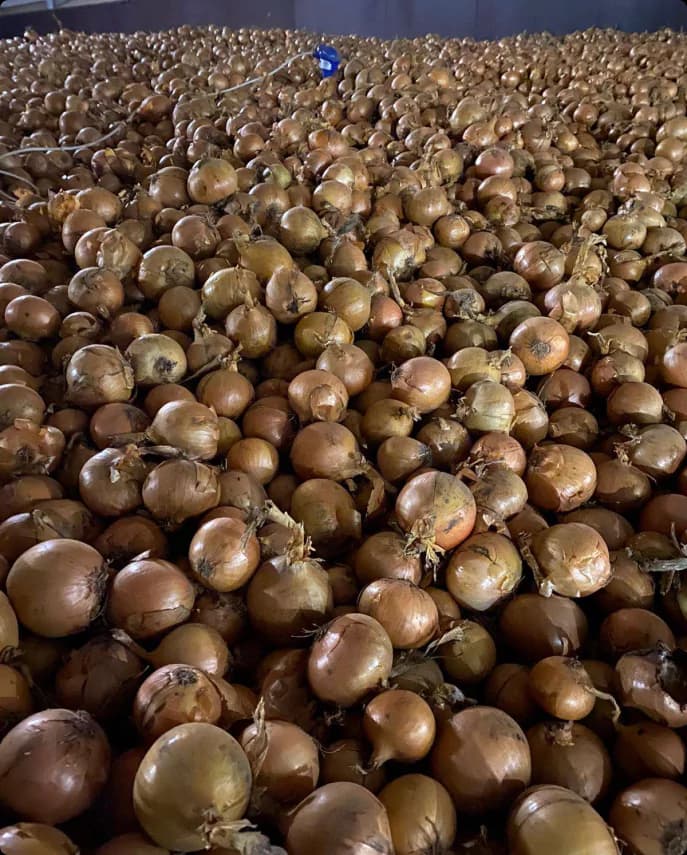
We do not fight Fusarium in the store, we fight it earlier. We grow around 250 ha of onions and keep them in our own 13 000 tonne storage facility, so every infected batch is a real loss.
- Crop rotation. The IO guidelines recommend a long break of several years before onions return to the same field. On our farm onions go to a different field every year, and cereals and other vegetables take over the fields after them, as we describe in our post on crop rotation in onion growing.
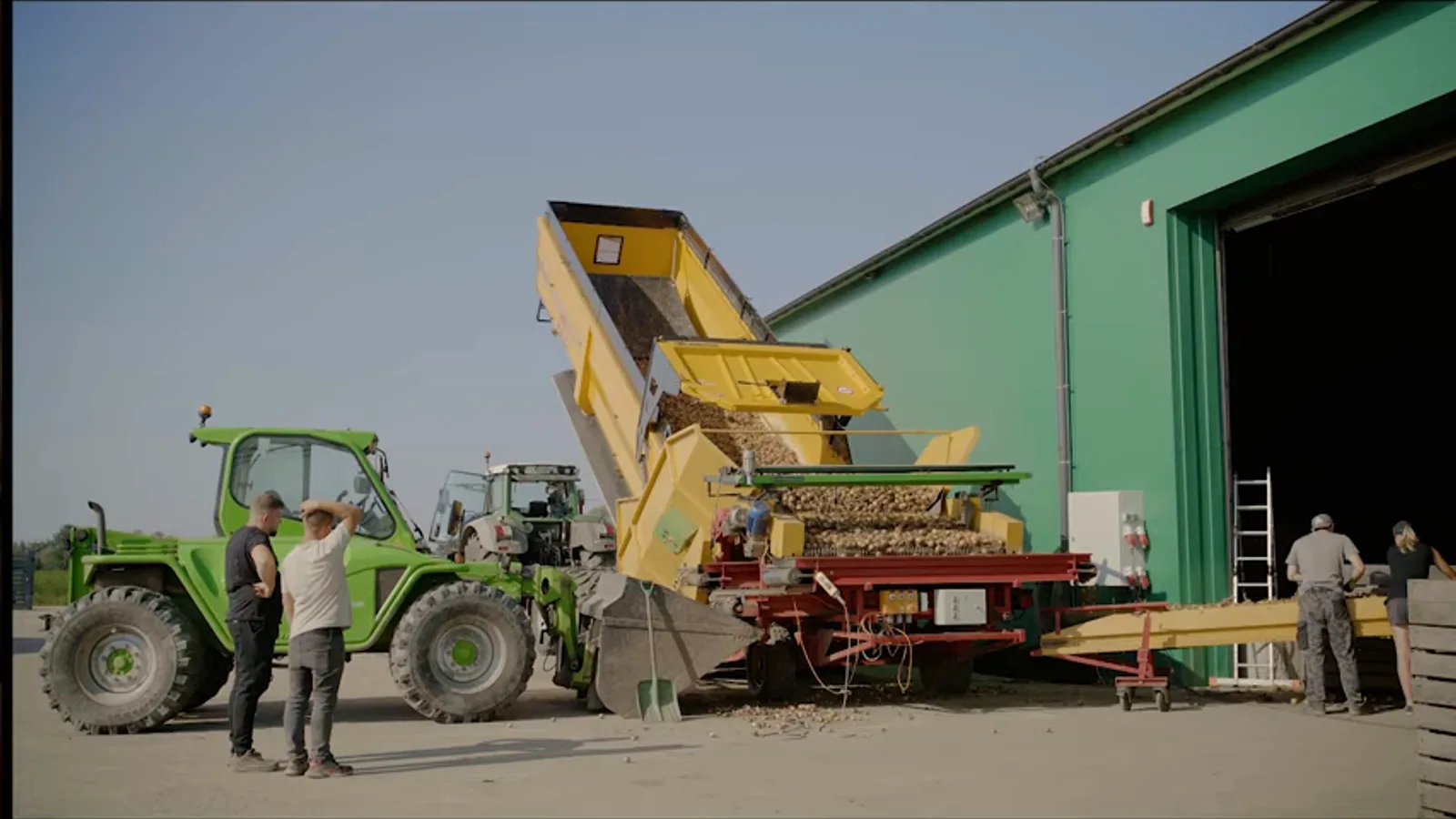
- Two-stage harvest. A Grimme WV 180 windrower lifts the onions and lays them in windrows, where they dry before going into storage. A self-propelled harvester then picks them up from the windrows. At every handling step we make sure to wound the onions as little as possible, because a wound is an open door for the fungus.
- Curing and gradual cooling. Once the onions are in from the field, we cure them for 2-4 days, then cool them gradually, over several weeks, down to 0-2°C. We go into detail in our posts on curing onions before storage and on what temperature to store onions at.
- Checks during storage. We check batches in the chambers throughout the season, because it is better to find an outbreak in December than on a customer's ramp in March.
- Grading before packing. The DOWNS CropVision optical sorter looks at every onion through 360 degrees and rejects defective bulbs, including those with signs of rot, at up to 100 t/h.
The sorter and batch checks reject bulbs with visible symptoms. No machine can detect a latent infection, which is why we do most of the work in the field.
We show the onion's whole journey from field to chamber and from chamber to pallet in our guide to storing onions.
What this means for the buyer
Fusarium basal rot is treacherous for buyers, because an infected batch can look fine for several weeks and then start rotting in transport or on the shelf. That is why, when buying onions from storage, it is worth asking not only about the size grade but also about how the batch was stored and whether it was graded just before packing.
We supply onions all year round: from autumn to spring mainly from our own store, and in summer also onions grown from sets. We grade onions from the store before dispatch. You will find sizes, varieties and packing options in our onion offer. If you need a batch to a specific specification, write to us via the contact form. We price on the basis of current market prices.