The MRL, or maximum residue level, is the legal limit on the amount of a specific active substance in a specific product, expressed in milligrams per kilogram. Produce within the MRL can be sold legally anywhere in the EU. For a B2B buyer, though, that is only the starting point: some retailers require much lower results, and we aim for results below the limit of quantification. We explain how to read these numbers.
What an MRL is and where it comes from
The rules for setting MRLs are laid down in Regulation (EC) No 396/2005. A limit always applies to a pair: one active substance and one product, for example a specific fungicide in onions. The same substance can have one MRL in potatoes and a different one in wheat.
An MRL is not a toxicity threshold. It is derived from good agricultural practice, that is, from field trials: what residue remains in the crop when a product is used according to its label, at the highest permitted rate and with the shortest pre-harvest interval. Only then does the European Food Safety Authority (EFSA) check whether that level is safe for consumers, including the most vulnerable. Non-compliance with an MRL, meaning a result that exceeds the limit even after measurement uncertainty is taken into account, means the batch cannot be placed on the market. Most often it points to a mistake in how products were applied. It does not automatically mean the vegetable is harmful to health.
Where no specific MRL has been set for a given substance and product pair, a default limit of 0.01 mg/kg applies. Current limits for every substance and crop can be checked in the EU Pesticides Database, run by the European Commission.
Limit of quantification versus limit of detection
These are the two terms most often confused in conversations about "zero residues".
| Term | What it means | How it appears in a result |
|---|---|---|
| MRL (maximum residue level) | the legal limit for residues of a substance in a product | a figure in mg/kg in the limit column |
| Limit of quantification (LOQ) | the lowest concentration a laboratory can measure with confirmed accuracy | an entry such as "< 0.01 mg/kg" |
| Limit of detection (LOD) | the lowest concentration that can be detected but not yet measured | usually does not appear in the report for the buyer |
| Retailer secondary standards | a limit set by the buyer as a percentage of the MRL | written in a specification or contract, not in legislation |
The EU document SANTE 11312/2021 v2026, which describes the validation of methods for pesticide residue analysis, defines the limit of quantification as the lowest concentration validated with acceptable accuracy for the whole method. Watch the abbreviation: in Regulation 396/2005 itself, "LOD" stands for limit of determination, which in practice is the limit of quantification, not the limit of detection. That is why, in documents, it pays to look at the definition rather than the abbreviation alone.
How to read a batch test result
For each substance, a laboratory report gives one of two things: a numerical result, or a note that the concentration is below the limit of quantification. The second entry means the laboratory did not quantify the substance with its method.
With a numerical result, remember measurement uncertainty. Official controls assume a default of 50%. A sample is non-compliant only when the result, after subtracting the uncertainty, still exceeds the MRL. Example: with an MRL of 0.1 mg/kg, a result of 0.15 mg/kg is a numerical exceedance, but after subtracting 50% (0.075 mg/kg) it gives no grounds to find the sample non-compliant in an official control. A result of 0.25 mg/kg gives 0.125 mg/kg after subtracting the uncertainty, and that is non-compliance. This is the rule for inspection authorities. In commercial acceptance, a result above the MRL, and for some retailers already above one third of the MRL, usually means the batch is rejected.
When assessing a report from a supplier, check four things:
- whether the test was done by an accredited laboratory and the sample comes from a specific batch, not "from the farm in general",
- whether the scope was multi-residue, covering a broad package of substances,
- what limits of quantification the method has for the key substances,
- whether the result can be linked to the field and the harvest date, which we cover in our post on pesticide residue testing of our batches.
Why retailers demand a fraction of the MRL
The law says "up to the MRL", but some retailers, especially in Germany, set their own, stricter limits. For example, the current purchasing policy of one of the large German discount chains, in its September 2025 version, sets these conditions for fruit and vegetables:
- a single active substance at no more than one third of the MRL,
- the sum of MRL utilisation by all detected substances at no more than 80%,
- no more than 5 detected active substances per sample.
Other retailers have similar lists, with their own thresholds.
For a supplier, this means that produce which is legal can still fail the buyer's specification. The margin has to be built in the field: you cannot count on breakdown in storage, and a batch above the MRL must not be diluted by mixing it with other produce.
Who checks residues
In Poland, vegetables at primary production, meaning straight from the farm, are checked by the Polish State Plant Health and Seed Inspection Service (PIORiN). Food on the market is checked by the State Sanitary Inspection. EFSA collects the results from across the EU. In the EU coordinated programme for 2024, published on 5 May 2026 (the basket included, among others, aubergines, bananas, broccoli, sweet peppers, table grapes, wheat, olive oil and eggs, but not onions or potatoes), 43.1% of 9,842 samples had no quantifiable residues, 54.5% were within the limits, 2.4% exceeded the MRL and 1.2% were found non-compliant after measurement uncertainty was taken into account.
How we work
We produce using a technology free of pesticide residues, in line with the principles of Integrated Plant Production. In practice, the goal is not to fit within the MRL, but a result below the limit of quantification. We plan crop protection so that substances have time to break down before harvest, with a margin over the pre-harvest interval, as we describe in our post on the pre-harvest interval in onion growing.
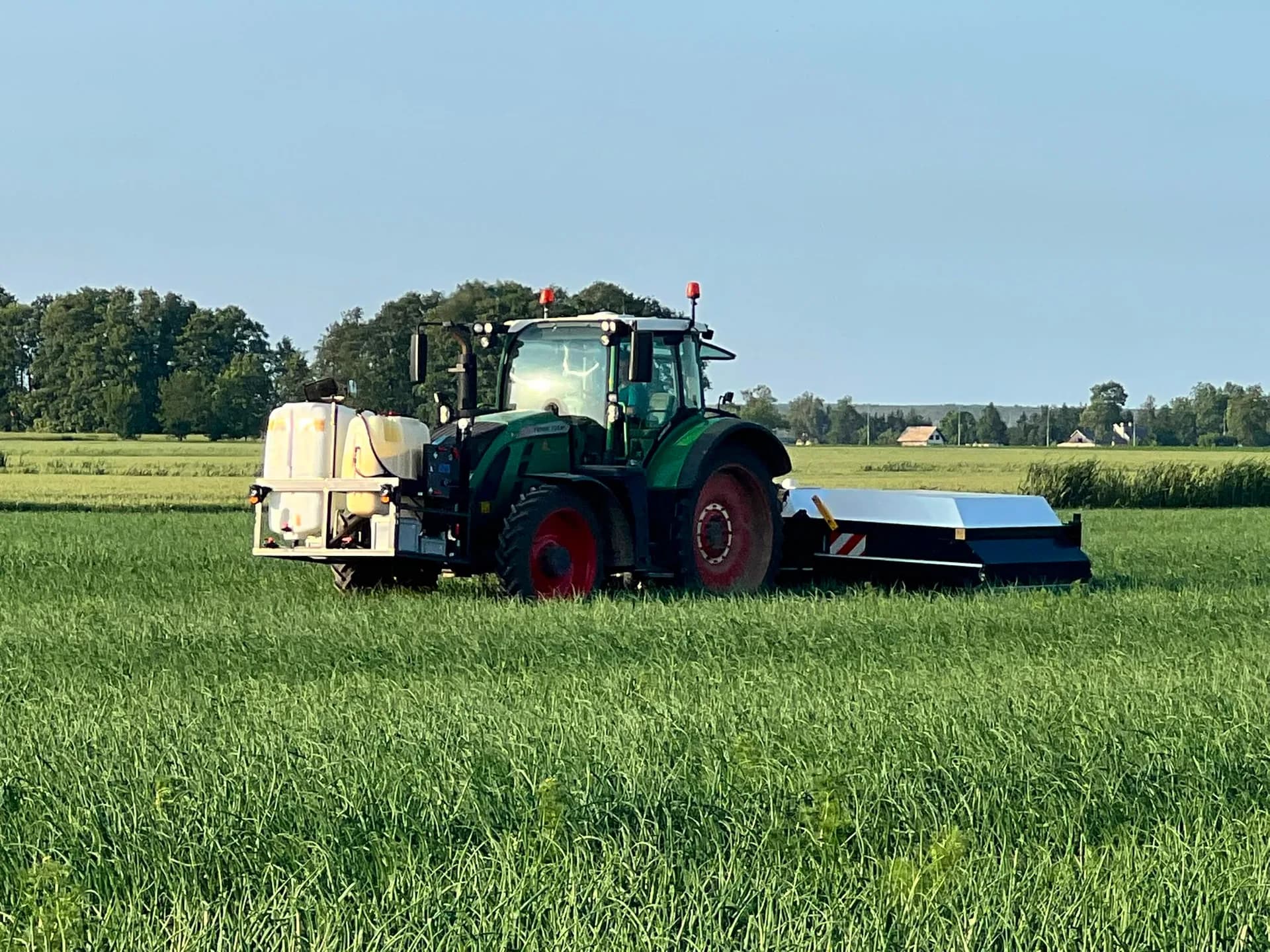
Precision makes the biggest difference. The Ecorobotix ARA spot sprayer cuts our chemical doses by around 70%. We check every batch, and the tests cover pesticide residues, heavy metals and substances hazardous to health. We break down the difference between organic, conventional and residue-free produce in our comparison organic or residue-free onions.
We grow about 250 ha of onions and sell them to packing houses and processing plants, as we describe in our post on wholesale onions straight from the grower. You will find varieties, sizes and packaging in our onion offer. If your specification sets a limit as a percentage of the MRL, write to us through the contact form and we will prepare an offer together with the test documents. We calculate the price from current market prices.