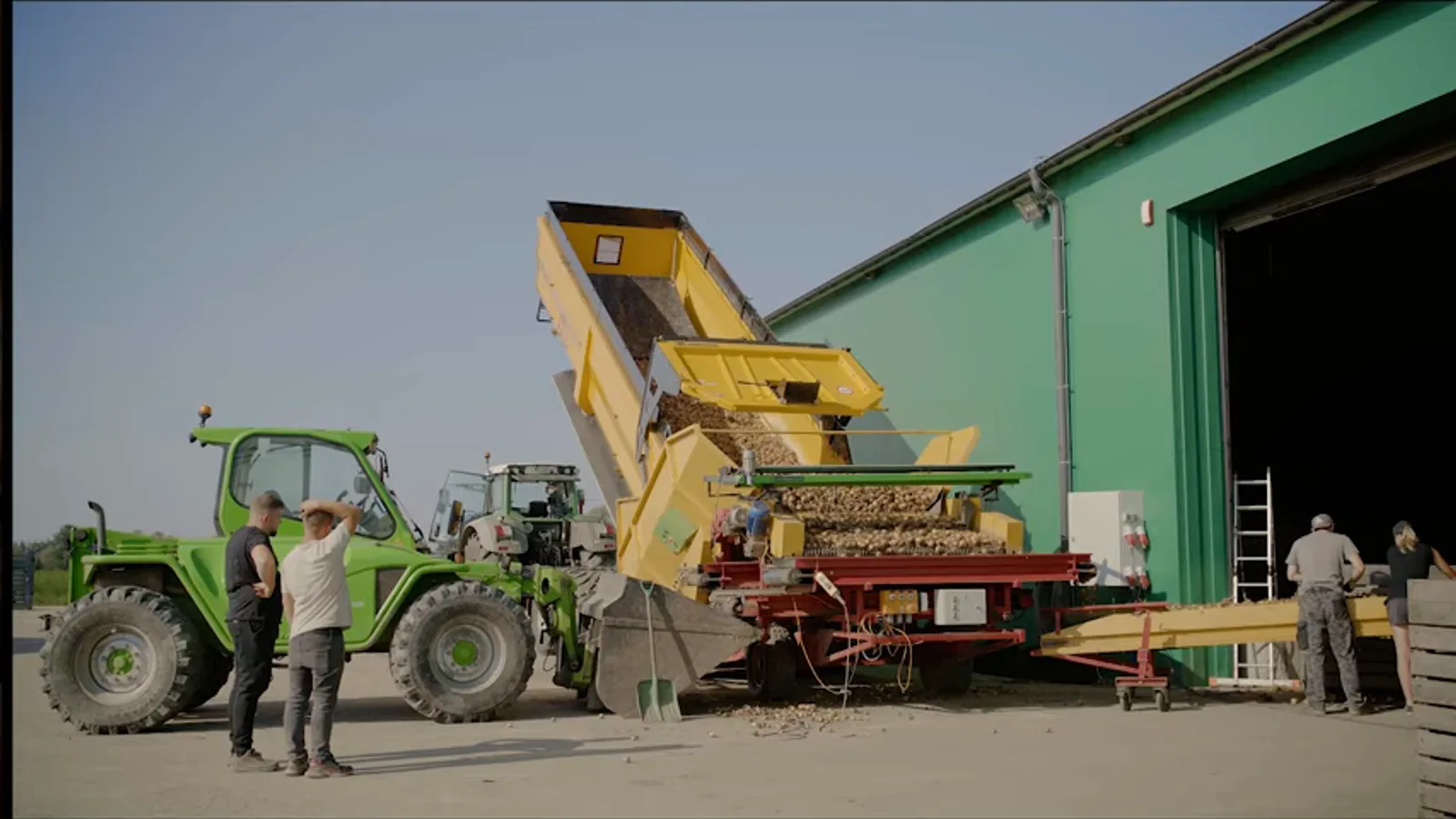
For us, hauling onions off the field is a separate operation, planned just as carefully as the harvest itself. In good conditions the AVR Puma 3 harvester picks up to 150 tonnes of onions an hour and tips them on the move into a trailer driving alongside, so it is the trailers, not the machine, that set the real pace of the day. We show how we put this chain together on around 250 hectares of onions in the Żuławy region, from the windrow in the field to the gate of our 13,000 tonne store.
Why haulage sets the pace of the harvest
On paper the harvest depends on the harvester. In practice the harvester stands still when there is nothing to tip into. The bunker of the AVR Puma 3 holds 8 tonnes and at full output fills in about three minutes. If the tractor and trailer do not make it back from the store in time, a 469 hp machine waits on the headland, and every minute of standstill is several tonnes of onions that have not left the field.
That is why we do not plan the harvest around the harvester but around the haulage loop: how far away the field is, how long the run, the unloading and the return take, and how many tractor and trailer units are needed so that there is always an empty trailer under the harvester. We look at harvesting onions with a harvester as a single production line in which haulage is the tightest bottleneck.
At 150 t/h, the harvester empties its 8-tonne bunker roughly every three minutes, and we change the full tridem trailer roughly every ten minutes. That is not an exception, it is the normal arithmetic of a good harvest day.
What the chain from windrow to store looks like
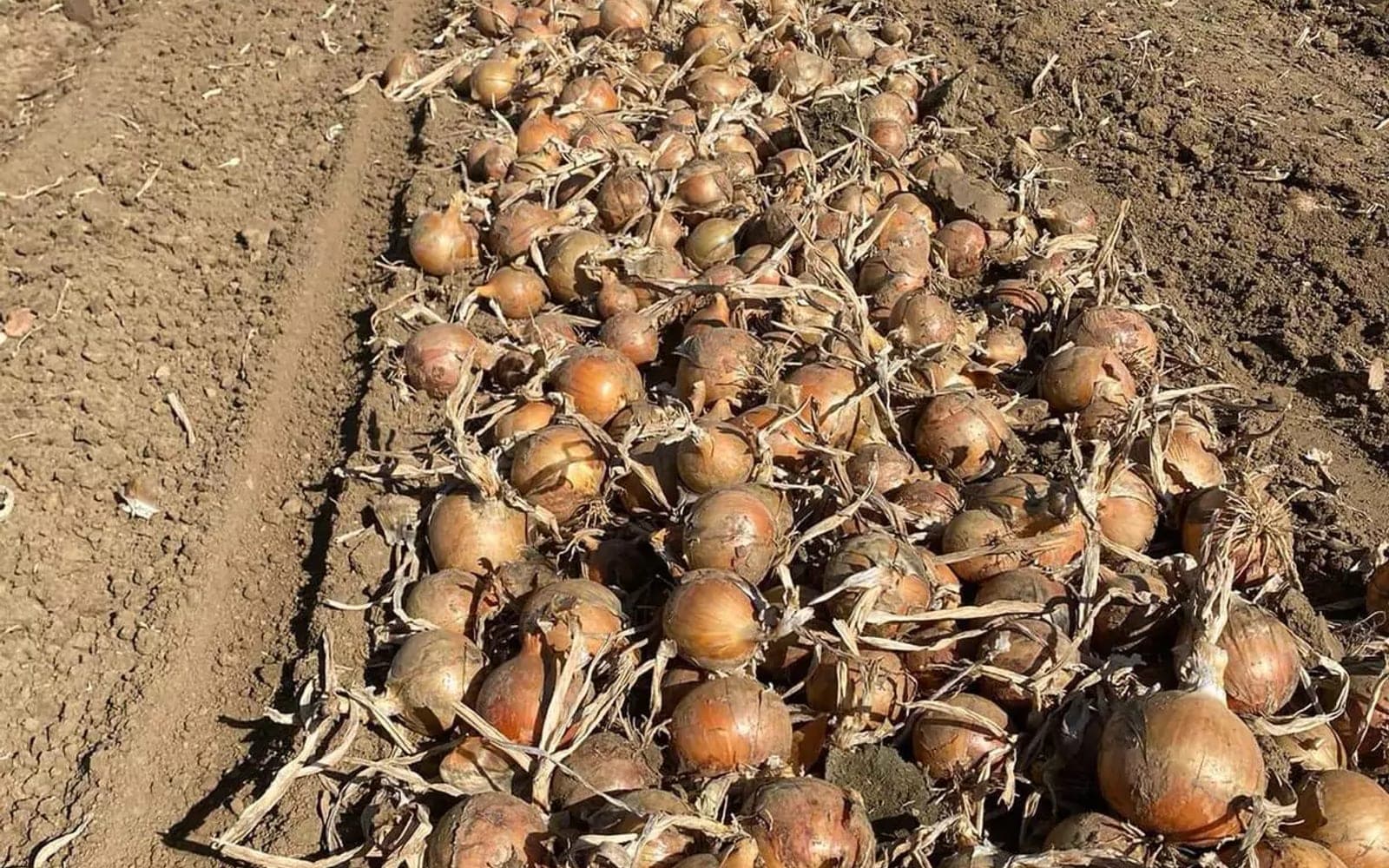
We harvest onions in two stages. First the Grimme WV 180 windrower lifts the onions and lays them in windrows, where they dry. Then the harvester goes in, and beside it, in parallel, a tractor with a trailer. Each of the following stages has its own machine and its own job.
| Stage | Machine | What we watch |
|---|---|---|
| Picking up from the windrow | AVR Puma 3, two windrows at once | clean pick-up, gentle sieving |
| Unloading on the move | 8 t bunker, unloading without stopping | matched pace of both machines, low drop height |
| Haulage off the field | John Deere 6930 Premium, Wielton tridem trailer | steady field-to-store loop, no harvester standstills |
| Intake at the store | intake line in the store | batch labelled, onions straight into drying |
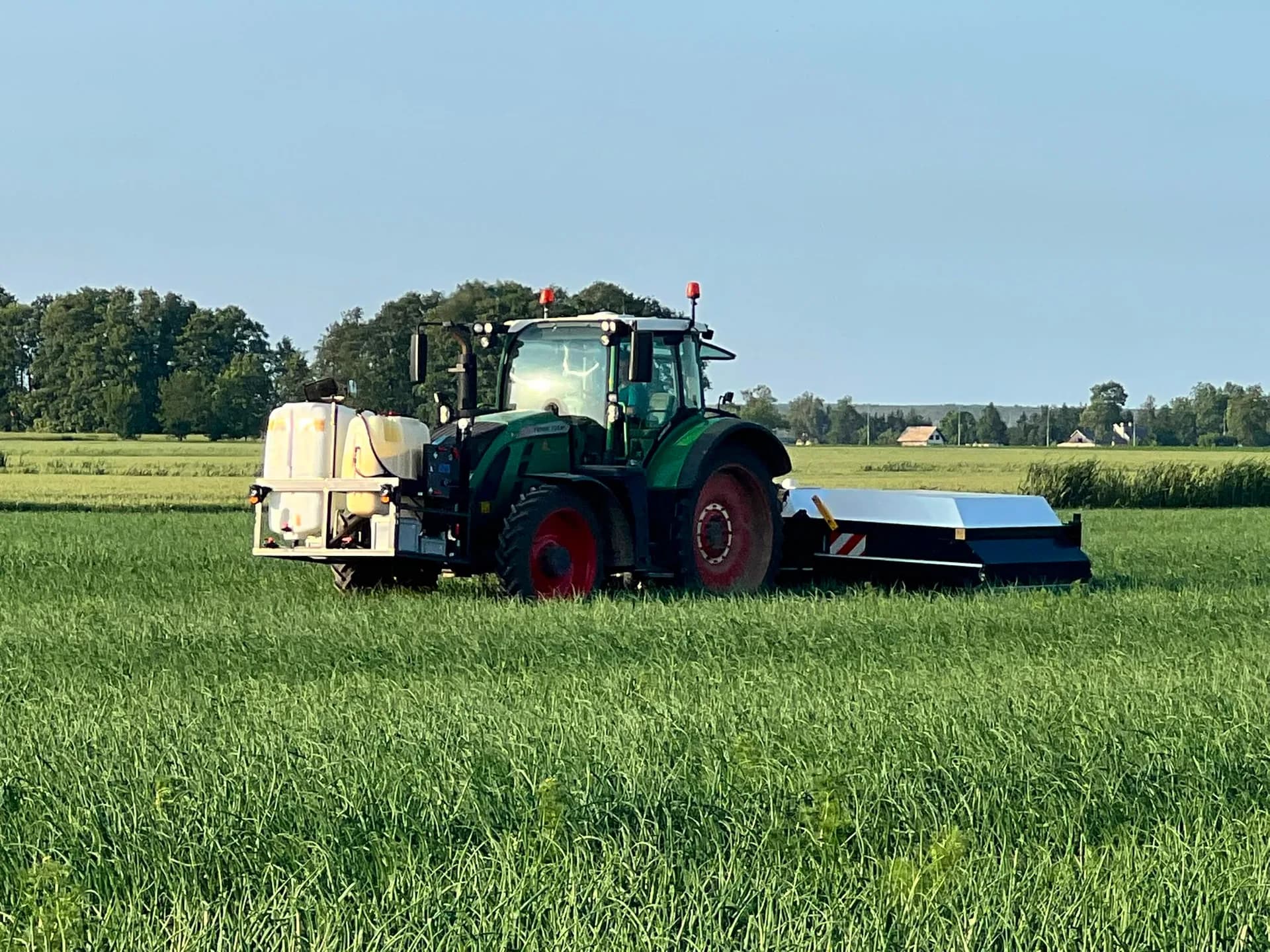
For haulage we choose mid-range tractors, not the most powerful machines in the fleet. When driving alongside the harvester, what counts is manoeuvrability on the headlands, a pace matched to the machine and low ground pressure, not record horsepower. More about this division of roles in the post on Fendt and John Deere tractors on the farm.
How many units are needed: simple arithmetic
The number of units in the loop depends on three things: the distance from the field to the store, the unloading time and the pace of the harvester. A field right next to the farm needs fewer trailers than a plot at the far end of Żuławy. That is why, before the season, we map out the order in which fields are harvested, so that the more distant plots are lifted when we have more free tractors and people.
A few rules we keep to whatever the field:
- An empty trailer always waits under the harvester. We would rather have a tractor waiting than a machine with several hundred horsepower.
- One operator watches the whole loop. They know the harvester's pace and decide who leaves the field and when.
- Trailers run in fixed tracks. Thanks to GPS guidance we do not compact the soil in random places, which matters for the next crop in the rotation.
- Bigger trailers go to the distant fields. A tridem trailer takes more per run, so the number of journeys drops.
How we protect the onions in transit
After harvest an onion looks hard, but its skin is still delicate and the neck not yet closed. Every knock from the field or the trailer is a spot where infection gets in during storage. That is why we treat haulage as a stage of protecting the produce, not just moving bulk.
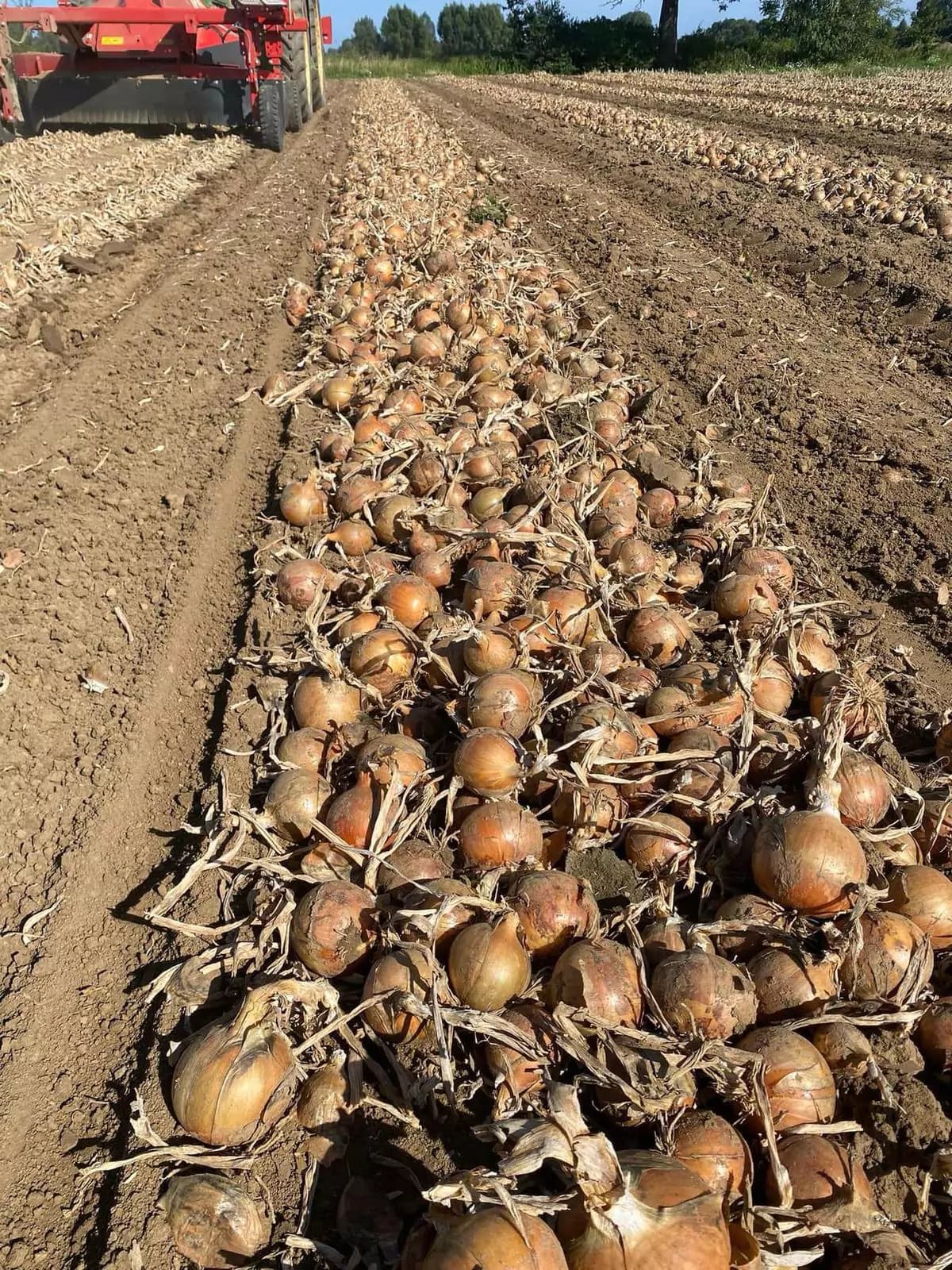
The most important thing is for the onions to fall from the lowest possible height. When unloading on the move, the harvester operator keeps the discharge elevator low over the trailer and raises it only together with the growing layer. We do not overload trailers above the sides, we do not tip the onions over several times and we do not leave loaded units standing in the sun. Onions from the field go straight to the intake line, and from there into drying.
A bruised onion will not show the fault straight away. The problem surfaces after a few weeks in the store, as neck rot or soft pockets in the heap. That is why gentle handling is an investment in what the buyer will receive in February.
Intake at the store and drying
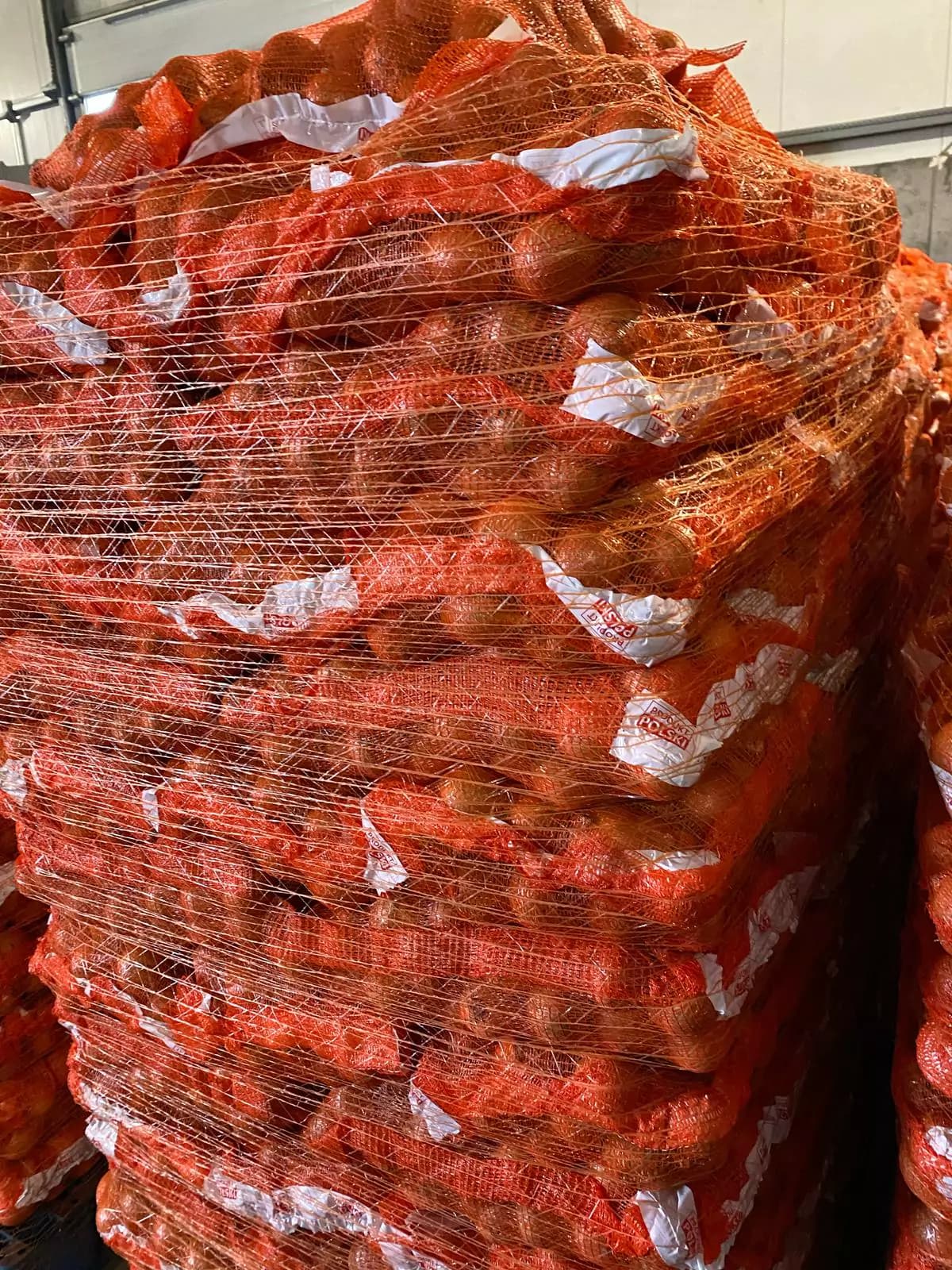
Every trailer that enters the store is assigned to a specific batch: field, variety, harvest day. That is how we build the traceability required by GlobalG.A.P., and thanks to it we know which part of the store is waiting for which buyer.
Onions from the field do not go straight into long-term storage. First, for 2-4 days, they go through drying with warm air to close the neck and set the skin. Only then do we lower the temperature and proper onion storage begins, which lets us sell produce all year round.
What well-organised haulage gives the buyer
To a packing house or processor, haulage is invisible, but its effects show in every delivery. Onions that came off the field without bruising and without waiting on a trailer cope better with the season in store and give less waste on the sorting line. A fast harvest also means we take the crop in a good weather window, before the autumn rains spoil the quality of the skin.
As a result, the onions in our offer have the same quality in autumn and in spring, and we can plan deliveries around the buyer's calendar. Our machinery, including harvesters, tractors and trailers, is shown on the machinery page. If you are planning onion deliveries for the coming season, write to us and we will agree the size, packaging and dates.