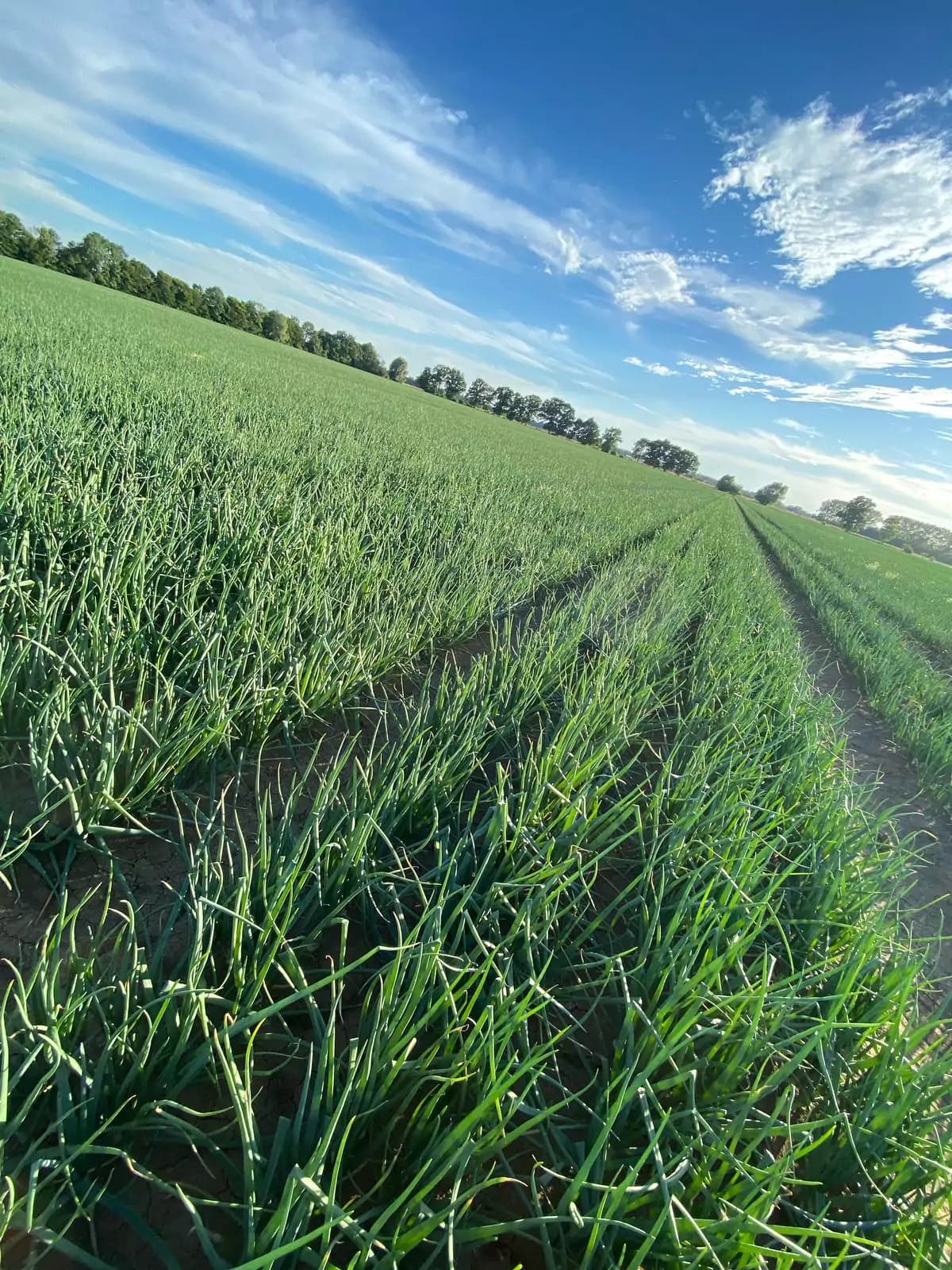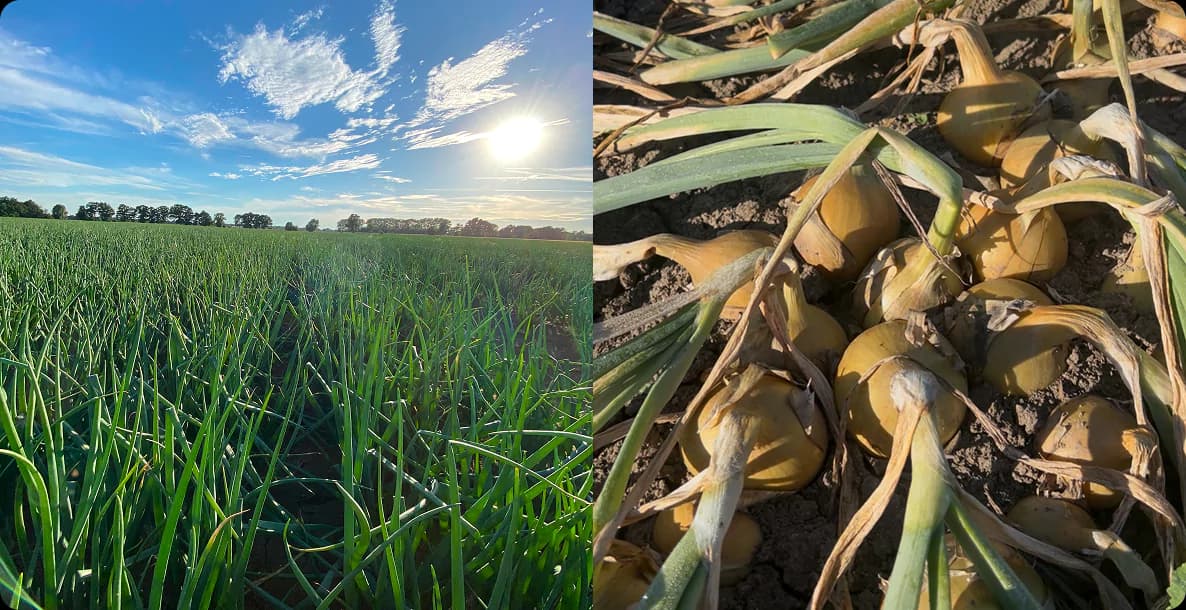
Onion yield per hectare is the first question anyone asks who is thinking seriously about this crop. According to GUS data from recent years, the average onion yield in Poland is just under 30 tonnes per hectare, but the spread between farms is enormous. We achieve a yield of around 60 tonnes per hectare. We grow onions on ~250 ha of Zulawy mada soils and aim for a high, even yield. In this post we explain what onion yield really depends on.
How much onion a hectare gives
The national average says little about a specific field, though. On a weak site a hectare may give a dozen or so tonnes, while intensive cultivation on good soils gives considerably more. A high, even result does not come out of nowhere. Several things add up to it: fertile soil, good varieties, precise agronomy and a storehouse that lets us deliver the crop to the buyer without losses.
Our onion area has grown from 2.5 ha, through 30 ha and 150 ha in the 2025 season, up to ~250 ha today. We grew so fast precisely because yields on our soils are repeatable and profitable. If a hectare gave little, we would not be increasing the area year after year.
Our reference point: high, even onion yields across ~250 ha of crops. That is a scale that places us among the best onion growers in Pomerania, where this crop is rare.
What onion yield depends on
Yield is not a matter of chance. Several factors shape it, and each one can raise or lower the result per hectare by a few, or even a dozen or more, tonnes.
Soil
Onion has a shallow, poorly developed root system, so it needs rich soil that holds water well. We grow it on Zulawy mada soils, some of the most fertile in Poland, with parameters close to Dutch polders. Why this soil gives so much we describe in detail in the post on Zulawy mada soils for onions.
Variety
Not every onion yields the same. We reach for proven yellow Rijnsburger-type varieties such as Hybelle F1 and Hysinger F1, and the red onion Redtide F1. They give a high yield and store well, which matters as much as the tonnes from the field.
Weather and water
Onion grows all season with an exposed soil profile, so weather hits it directly. The wet 2025 season showed this clearly: downpours reached over 150 litres per square metre in a single day, drainage canals overflowed, and compacted soil gave up less of the crop. In Zulawy, a low-lying area, managing water is therefore part of the fight for every hectare.
Agronomy and crop protection
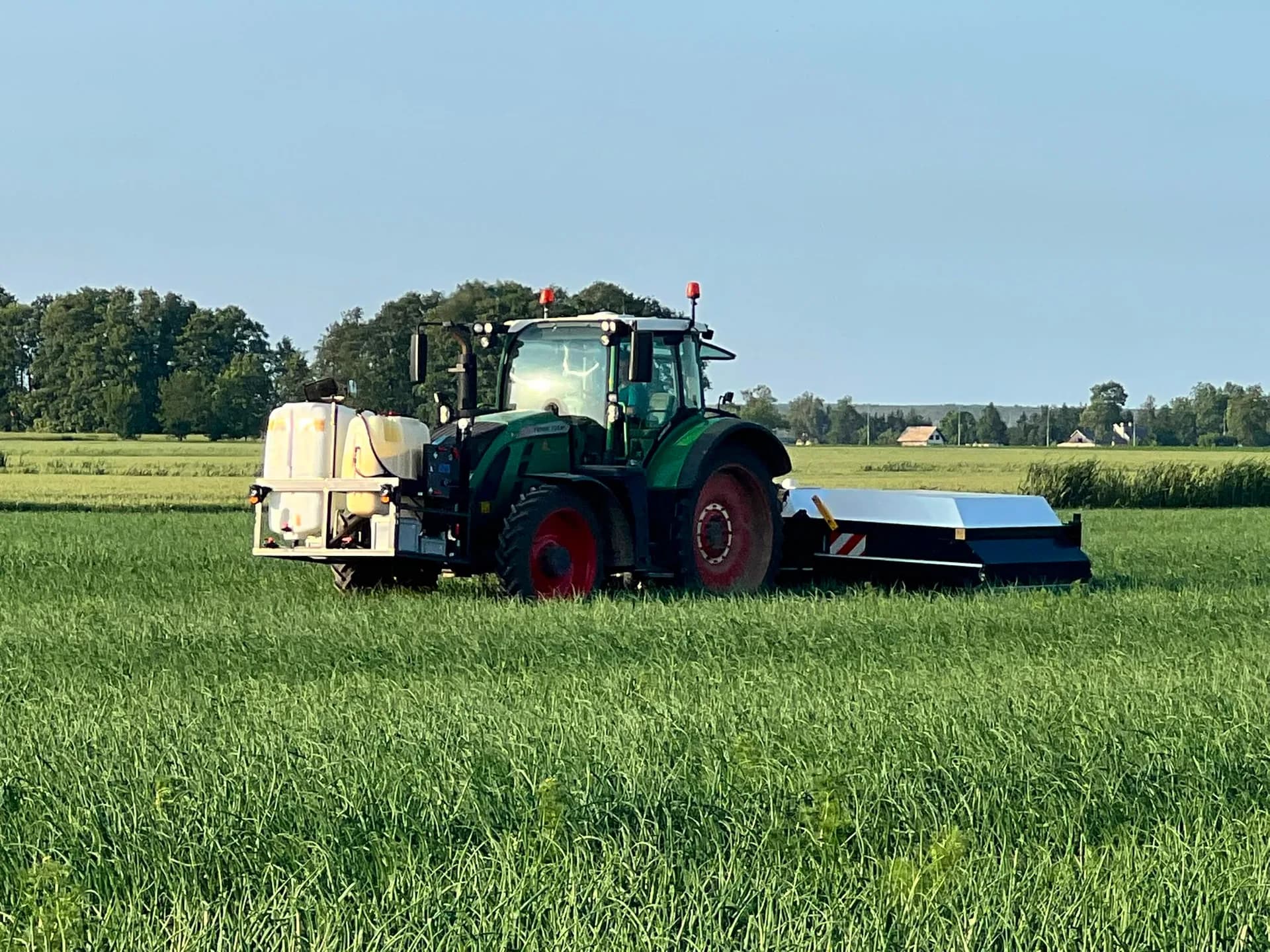
Even sowing, the right nutrition and effective weed control decide how much of the soil's potential can be harvested. We work in precision agriculture: GPS guidance with RTK correction, variable-rate fertiliser dosing and the Ecorobotix ARA spot sprayer that works with us permanently. How we match doses to the needs of a given part of the field we explain in the post on variable-rate dosing in practice.
What raises and what lowers onion yield
| Factor | Effect on yield per hectare |
|---|---|
| Fertile mada with high humus | Raises, gives a store of nutrients and water |
| A good, productive, durable variety | Raises, more produce in the desired size |
| Soil compacted after downpours | Lowers, roots work worse |
| Pressure from secondary weeds | Lowers, competition for water and nutrients |
| Variable-rate dosing and even sowing | Raises, fewer losses, an even plant |
| Drought in key weeks | Lowers, onion does not fill out |
A high yield is not everything
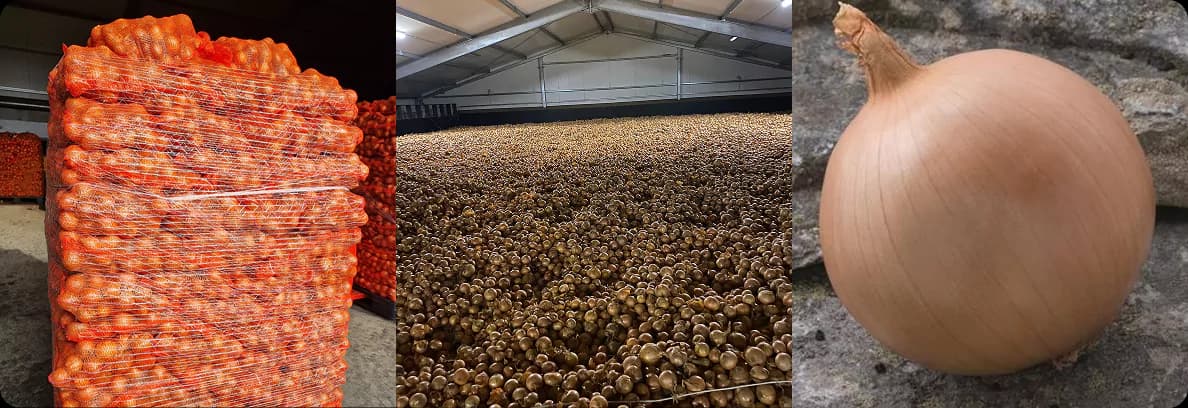
Tonnes per hectare are impressive, but for a wholesale buyer what happens after harvest matters just as much. A high yield is easy to lose if the onion is not well dried and stored. That is why, once lifted, it goes to our storehouse of about 13,000 tonnes. First we dry it for a few days, close the neck and remove excess moisture, and only then it goes into long storage. How we do it exactly we describe in the post on onion storage.
Evenness matters too. A high but uneven yield means more waste after grading. Our onion from uniform mada grades well for a specific buyer, which we write about in the text on onion size for processing.
What it means for a wholesale buyer
For packers and processors a high, repeatable yield per hectare is a signal that the supplier has scale and stability. On top of that, we offer:
- High, even onion yields across ~250 ha of crops.
- GlobalG.A.P. and GRASP certificates and farming to the rules of Integrated Plant Production.
- Tests for residues of pesticides, heavy metals and substances hazardous to health.
- Our own storehouse of about 13,000 tonnes, thanks to which we ship produce all year round.
Our whole way of growing onions on these soils we describe in the guide on growing onions in Zulawy. We calculate the price based on current market prices, and our onion and other vegetables you will find in the onion offer.
Looking for onion from high-yielding Zulawy fields in repeatable quality? Write to us via the contact page or see how we grow our onions.