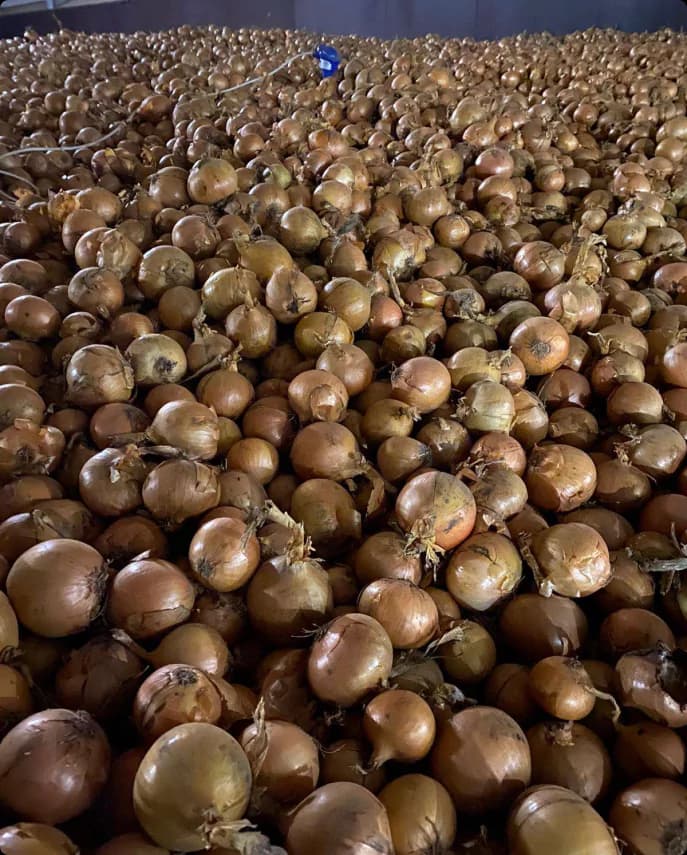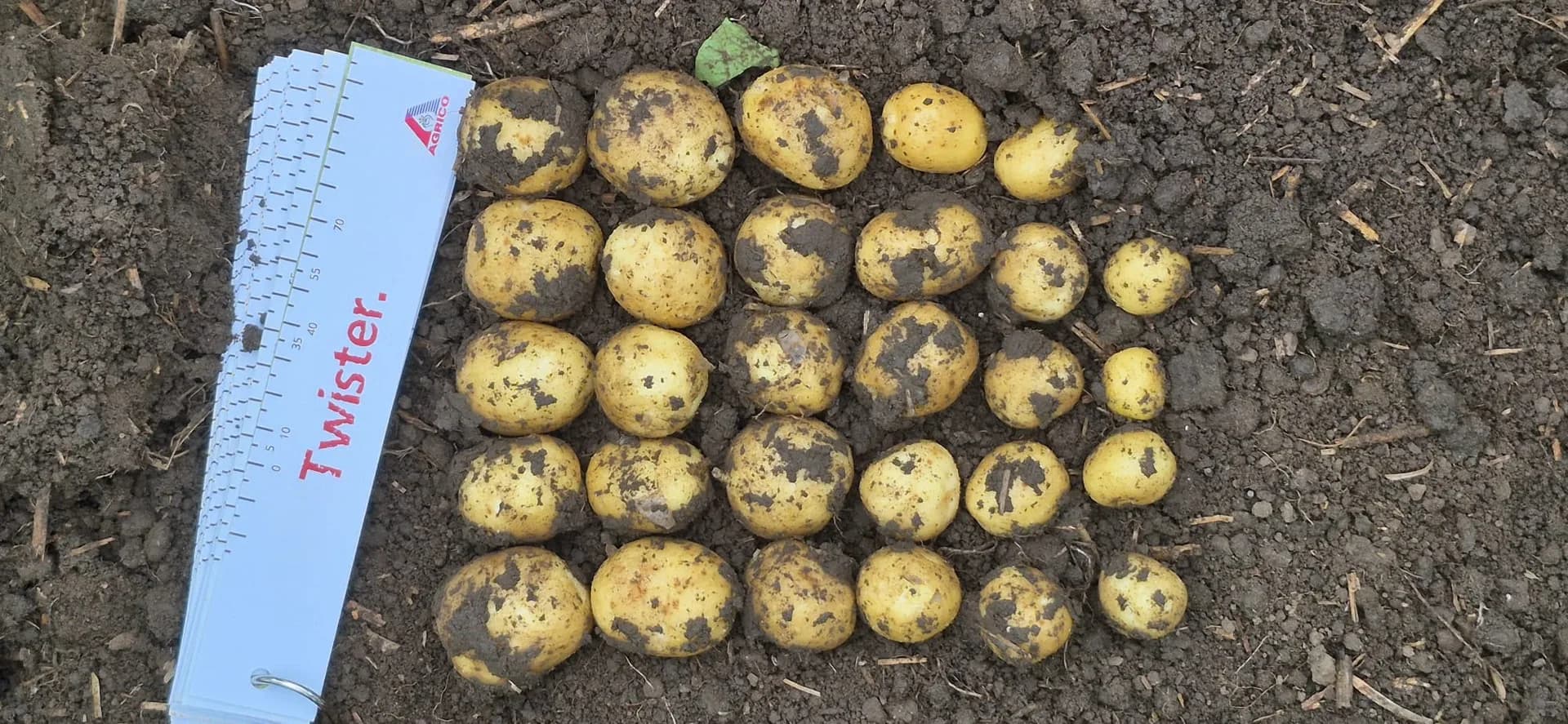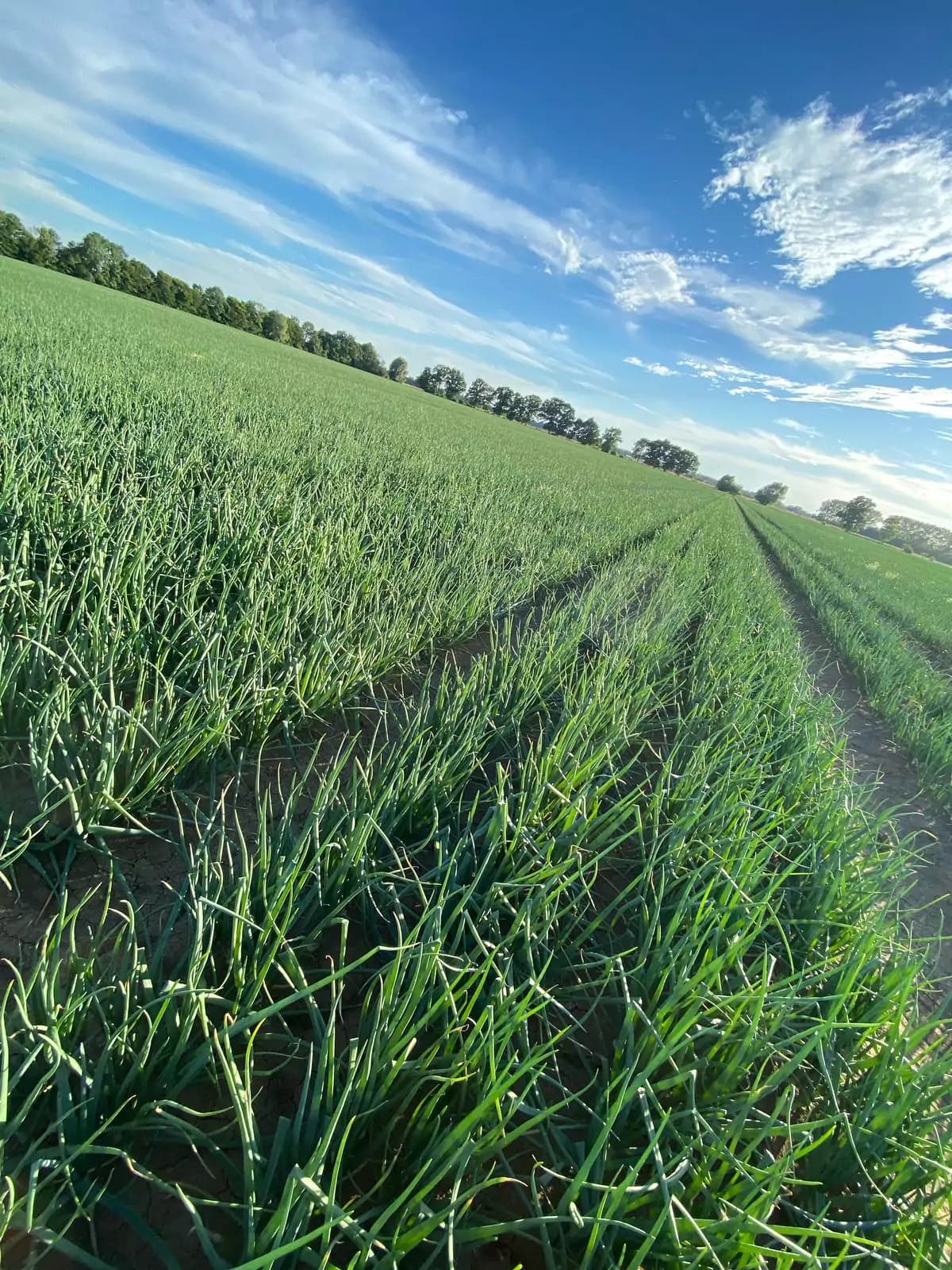
We sow a cover crop on those fields after vegetables that do not go straight into winter wheat. The mix comes up in autumn, covers the alluvial soil through the winter, holds the nitrogen left over from fertilising and leaves roots in the top layer that improve its structure. In the Żuławy region this is not agronomic decoration, because soil left bare all winter loses exactly the qualities that make this land worth so much.
Why bare alluvial soil loses through the winter
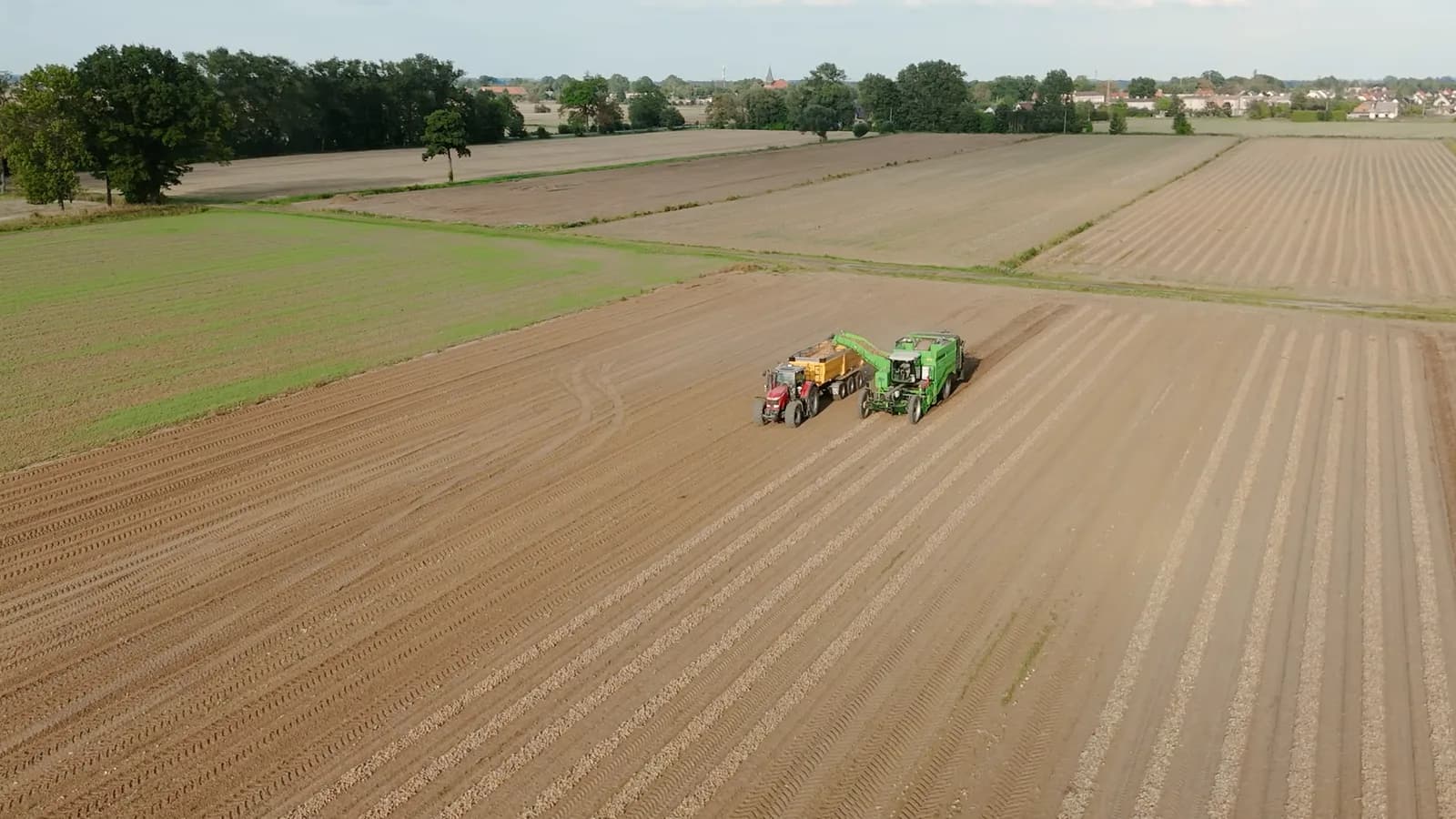
Onions are a crop that keeps the soil profile open all season: the rows are narrow, the plant never closes over the inter-rows, and after harvest a bare, dried-out top layer is left on the field. Potatoes and beet come off later, but they leave soil heavily worked over by machines.
Through the winter such a surface works against us:
- rain breaks down the aggregates and silts up the top layer, and once it dries a crust forms,
- mineral nitrogen that no plant will take up any more moves down the profile and into the water,
- on flat, open ground the wind blows away the finest particles, and water runs off into the ditches instead of soaking in,
- soil compacted at harvest stays compacted, because there are no roots to loosen it.
Compaction is a separate, big subject, which we describe under protecting our Żuławy alluvial soils from compaction. A cover crop will not repair a wheel rut, but it rebuilds the layer in which the next onion crop has to come up.
When a cover crop, and when a winter cereal straight away
We take the decision field by field, not for the whole farm. Two things count: when the field comes clear and what is to grow on it the following year.
| Situation in the field | What we do | Why |
|---|---|---|
| Onions came off on time, the field goes into winter wheat | we drill the cereal, no cover crop | the winter cereal is the winter cover itself |
| Onions came off late, the drilling window for the winter cereal has passed | a cover crop mix, and when the field comes clear very late, outside the eco-scheme | cover and nitrogen held back, a spring crop drilled in spring |
| Field after potatoes or beet, harvested in autumn | a cover crop only if the field comes clear early | after a late harvest the plant will not build any biomass in time |
| Field planned for a spring crop | a cover crop | a winter without cover would be a net loss |
What happens on the fields that go into cereals, we describe step by step in our post on what to sow after onions. Where cereals sit in the whole arrangement we explain under crop rotation in onion growing.
What goes into the mix
We choose the species for what is to grow afterwards, not for what happens to be cheap. The most important rule: a cover crop has to fit the rotation, otherwise it multiplies the diseases of the next crop.
| Species | What it brings | What we watch out for |
|---|---|---|
| White mustard | fast emergence, plenty of biomass, cheap | a brassica, it multiplies clubroot |
| Oil radish | a deep taproot, loosens the layer below cultivation depth | also a brassica, ahead of beet we pick nematode-suppressing varieties |
| Phacelia | related to nothing else in our rotation, good structure | dearer seed, sensitive to frost |
| Oats | cheap, plenty of fine roots, winterkills well | on its own it fixes no nitrogen from the air |
| Winter vetch and pea | they fix nitrogen from the air | a slower start, they need earlier drilling |
In practice we sow mixes rather than a single species, because different root systems work at different depths, and a mix is also a condition in the support schemes. On fields that go into onions we avoid a large share of brassicas and go for phacelia with oats, or mixes with legumes.
A cover crop has to be destroyed, or left to winterkill, before it sets seed. Mustard and radish that manage to shed seed come back in later crops as a weed, and that is the last thing onions need, weak as they are against weeds. Watch out for fields entered into the eco-scheme: there, plant protection products are banned until 15 February, and mulching is allowed only after 15 November, with the mulched cover left on the field until 15 February. The timing and method of destruction have to be planned around those conditions.
Formal requirements worth keeping in mind
Beyond agronomy there is the subsidy side, and that is usually what sets the dates. Two things are worth knowing:
- The GAEC 6 standard, the duty to keep soil cover on most arable land through the autumn period. The exact dates and the breaks allowed for preparing the field have changed between campaigns.
- The eco-scheme for winter cover crops and undersown crops (ekoschemat międzyplonów ozimych i wsiewek śródplonowych). The conditions here are tighter. In the 2026 campaign the rule is a mix of at least 2 plant species (not cereals alone), sowing by 1 October, cover kept until at least 15 February 2027, and a ban on plant protection products in that period. Mulching a cover crop is allowed after 15 November. Sowing after the deadline lowers the payment: by 30 percent for sowing up to 15 October and by 70 percent after that date.
We check the dates and the details with ARiMR before every campaign, because the rules can change from year to year, and a mistake costs the payment, not just the yield.
What the onions get out of it when they return to the field
A cover crop does not pay for itself in the season we sow it. You only see it when onions come up on that field: the soil is less crusted, it is easier to prepare an even seedbed for a small seed, and water from the spring rains soaks in faster instead of standing in the ruts. In a crop where the yield is decided by even emergence, that is a real difference, not a cosmetic effect. How we prepare a field for onions, we describe in our post on preparing the onion field in autumn.
We farm more than 800 ha, so we take these decisions field by field, right through the autumn. That way the onions from around 250 ha come back every year onto soil in good shape, not onto a field worn out by the previous season. Where the quality of the land itself comes from, we explain under Żuławy soils for onions.
If you are looking for a vegetable supplier who looks at a field over several seasons, take a look at our onion offer and get in touch through the contact form.